
When sourcing a wheeled laundry basket, start with a specification that separates the basket, supporting structure, liner and wheels. A product photograph helps explain the design, but it does not establish usable capacity, permitted load, cleaning requirements or packed size.
For importers, distributors and private-label buyers, the practical task is to make supplier offers comparable. Define the intended use, record how dimensions are measured and identify which features must appear on the approved sample. Then compare quotations against that same specification.
Wheeled Baskets, Hampers, and Sorters: Define the Product You Need
Product names overlap. A basket generally carries laundry between locations; a hamper generally holds laundry before washing; a sorter separates it into compartments. Wheels can appear on any of these designs. For a fuller terminology comparison, see laundry basket vs. hamper.
Write the intended use before choosing the configuration. A household collection basket, a retail sorting unit and a cart for an institutional laundry route need different purchasing briefs. Do not assume that a household product meets a commercial handling requirement simply because it has wheels.
- Collection: Decide whether the product needs a lid and whether laundry stays inside until washing day.
- Transport: Describe the route, floor surfaces, doorways and any points where the basket must be lifted.
- Sorting: Specify separate bags, fixed dividers or removable baskets.
- Storage: Decide whether the product remains assembled or must fold, nest or stack between uses.
Put these requirements in the enquiry instead of relying on labels such as large, portable or heavy duty.
Compare Dimensions and Capacity Descriptions Together
Ask for assembled external dimensions, usable internal dimensions and the measurement method behind any stated volume. External width and depth should identify whether handles, wheels and other projections are included. Height should state whether it includes the handle or an open lid.
A rolling hamper’s specification can identify its bag material alongside its external width, depth and height. This is a useful example of a dimensional description, but external measurements alone do not establish the bag’s usable volume. Do not calculate capacity from the outer frame and present it as measured storage space.
Check for conflicting capacity figures in a product listing’s title and description. When this happens, request a corrected specification and align the quotation, packaging artwork and online product description before ordering. Choosing whichever figure looks more attractive leaves the underlying discrepancy unresolved.
Keep volume and load rating separate. Volume describes storage space; a load rating describes permitted weight under stated conditions. Ask whether the proposed load applies during stationary storage, rolling or lifting, and request supporting evidence for any performance claim.
For assortment planning, record the intended installation space as well as the basket size. Allow room to open the lid, remove a liner and reach a lower compartment. A basket that fits into a recess may still be awkward to use there.
Specify the Basket, Frame, and Liner Materials Separately
A material description should follow the components. Ask suppliers to identify the basket body, frame, base, liner, handles, fasteners and wheel assembly separately. Use the plastic and fabric laundry basket comparison for the broader material choice; keep the purchasing specification focused on the actual construction.
A woven rolling basket may use different materials for its body, base and supporting components. Calling that product simply a woven basket leaves out materials that matter when reviewing assembly, cleaning and replacement parts.
A wheel assembly’s material specification should distinguish the tire, wheel and any sleeves. Follow that component-level approach when preparing an enquiry. A description such as rubber wheels may not explain whether the whole wheel or only its outer tire uses that material.
A recycled-content claim may apply only to a basket’s textile component. Keep a recycled-content statement attached to the component it describes. It does not establish the recycled content, recyclability or environmental performance of the complete basket.
For an OEM order, require proposed material substitutions to be identified before approval. Record material descriptions alongside the sample reference so that a similar appearance does not become the only acceptance criterion.
Check Wheel Configuration, Locks, and Handles
List total wheel count and locking-wheel count as separate fields. Then specify wheel position, fixed or swivel movement, attachment method and access to the locking mechanism.
A model description should state how many wheels it has and how many of those wheels have locks. That wording is more useful than with locking wheels because it distinguishes the complete arrangement from the locking subset.
Ask what each lock restrains: wheel rotation, swivel movement or both. Review whether it can be operated with the basket loaded and the liner installed. A component description is not evidence of braking performance on every floor.
- Movement: Assess starting, turning and stopping with a representative load on the intended route.
- Clearance: Check the lowest part of the assembled product against relevant transitions and obstacles.
- Handle use: Distinguish handles intended for pushing or pulling from those intended for lifting.
- Maintenance: Ask how wheels attach and whether replacement assemblies can be supplied.
Agree on the sample evaluation conditions and acceptance criteria before testing. Record the load, floor surface and configuration used. Do not turn a successful movement demonstration into an unsupported claim about endurance, stability or floor protection.
Compare Removable Liners, Compartments, and Care Instructions
Specify compartment layout and liner construction together. Separate compartments do not necessarily mean separately removable bags, and a removable liner does not necessarily have handles suitable for carrying a full load.
A divided sorter may use a shared removable liner. For a similar configuration, ask whether the liner comes out as one divided unit or as independent bags. Check how it attaches to the frame and whether removal requires unloading either section.
Review the attachment points, seams, opening and fit on the sample. Try removing and reinstalling the liner with representative contents. If a replacement liner is part of the assortment, give it its own specification and confirm compatibility with the relevant frame.
For any basket under consideration, check its care instructions for permitted textile washing and drying methods and for how to clean the basket itself. The purchasing lesson is to separate textile care from care of the surrounding structure. Those instructions belong to that particular product.
Ask for care instructions matched to the approved materials and construction. Do not treat removable as a synonym for machine washable. For related liner-care considerations, see washable laundry bags.
Choose Between Folding, Stacking, and Two-Tier Designs
These configurations solve different space problems. Compare their operating arrangement, storage arrangement and shipping arrangement separately.
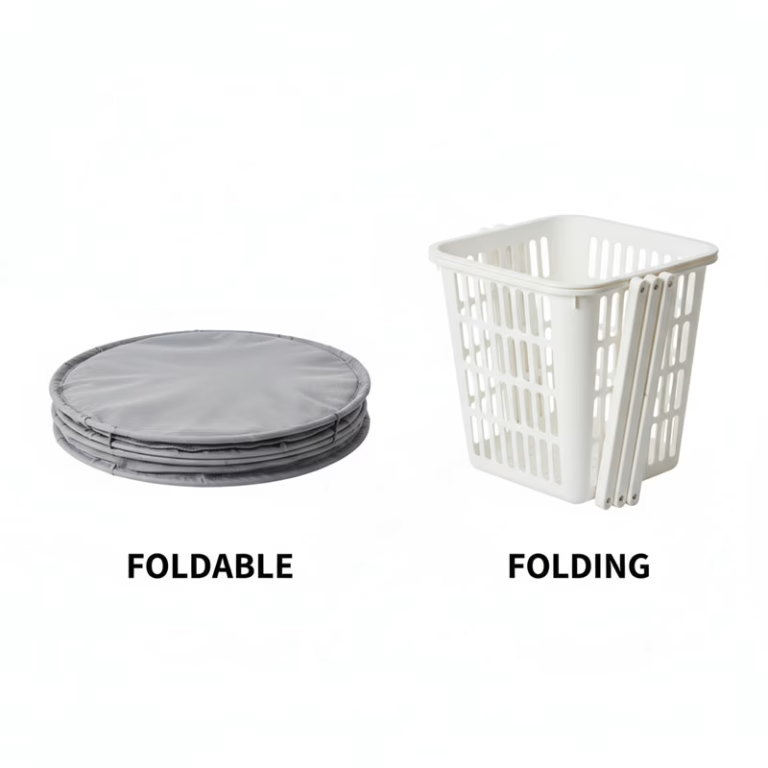
Folding designs
For a folding wheeled basket, define the required lid, handle materials and liner arrangement. Specify each feature independently. Do not assume that selecting a folding model also includes a lid or removable bags.
Check how much space a folding basket occupies when collapsed. Collapsed thickness is useful, but request the complete folded dimensions and clarify whether wheels, handles or liners must be removed. Check the folding sequence on the sample and identify any loose parts.
Stackable designs
For a stackable basket set, specify basket sizes, carrying handles and swivel-wheel requirements. For this type of set, confirm which parts carry the wheels and which stacking arrangements are intended for use. Distinguish loaded stacking from empty storage and transport packaging.
Two-tier designs
If a two-tier rolling cart includes a shelf, include it in the specification. This configuration needs more detail than a single basket on wheels. Specify shelf position, access to each level and any removable components. Ask for load information by section rather than treating an overall figure as permission to load every part equally.
Compare assembled, stored and packed dimensions across the shortlisted models. A compact storage format does not by itself establish the shipping volume of the finished retail pack.
Build a Product Specification for an OEM Enquiry
A useful enquiry lets suppliers quote the same product definition and identify exceptions clearly. Include the following information:
- Intended use: Sales channel, household or institutional application, handling route and storage location.
- Configuration: Basket arrangement, compartments, lid, shelf, folding or stacking requirements.
- Dimensions: Assembled, internal, folded and packed measurements, with units and measurement points.
- Materials: Separate descriptions for the body, frame, base, liner, handles and wheel components.
- Movement: Wheel arrangement, locks, handle function and proposed sample evaluation conditions.
- Care and service: Liner removal, cleaning instructions, replacement parts and assembly requirements.
- Branding and packaging: Artwork placement, labels, instructions, retail packaging and master-carton requirements.
- Commercial scope: Requested order quantities, delivery destination, quotation currency, trade term and any separately quoted tooling or development costs.
Ask for factory-measured specifications and photographs of the quoted model, including its base, wheel attachments, liner fixings and folded arrangement where applicable. Keep the approved sample, quotation and product specification under the same model reference.
Compare prices only after aligning the included components, packaging and delivery basis. Request quantity-based quotations and identify optional features separately. Retail selling prices are not a substitute for a wholesale quotation.
Yiwu Yihang Daily-Use Commodity Co., Ltd. has manufactured laundry and household storage products since 2014. Its assortment includes wheeled laundry baskets and folding laundry baskets; confirm the required combination of features for the selected model. Its stated markets include Europe, North America, South America, Korea and Japan.
Model-specific factory measurements and photographs: Ask our sales team for measurements and photographs of the model you are considering.
Model-specific wholesale quotation range: Ask our sales team for a current quotation based on your selected model, order quantity, packaging and delivery requirements.
Review the product catalog, then send your specification for an OEM or custom-design enquiry. Include the intended configuration and packaging requirements so the discussion starts with a defined product.
FAQ
Which factors should guide the choice of a laundry basket?
Start with intended use, available space and the route it must travel. Then compare usable capacity, construction, wheel arrangement, handles, liner care and storage format. For bulk orders, document these requirements against an approved sample.
How can I choose a laundry basket size that suits my home?
Measure the storage space and narrowest doorway on the route to the washing area. Allow room for opening the lid and removing the liner. Consider the laundry collected between washes, and compare internal capacity alongside external dimensions.
How does a laundry basket differ from a hamper?
A basket generally serves for carrying laundry, while a hamper generally holds it before washing. Product names overlap, so check the actual design. Either may have wheels, handles, a lid or a removable liner.
What does the term laundry basket mean?
A laundry basket is a container used to collect, hold or carry laundry. A wheeled laundry basket adds wheels for moving it along a floor. The name alone does not specify its materials, capacity or permitted load.