
A buyer orders 20,000 laundry bags. The samples look fine. Then the bulk order arrives, and the zippers jam after three washes. Returns pile up, and the brand takes the hit.
So who makes reliable wash bag mesh in China? The strongest suppliers share four traits. They run their own sewing lines, they have years of export history, their materials pass tests like REACH, and they support OEM orders with custom designs. A factory with all four is worth a place on your shortlist.
This guide shows you how to find those factories. You’ll see where they cluster, which mesh styles to compare, and how to check a supplier before you pay a deposit.
Key Takeaways
- Pick a real factory, not only a reseller. Direct makers control fabric, sewing, and quality checks in one place.
- Ask for test reports early. For Europe, REACH compliance is a must for textile goods sold to consumers.
- Compare mesh types side by side. Fine mesh, coarse mesh, and sandwich mesh each suit different items.
- Check zippers and seams, not just fabric. Most laundry bag failures start at the zipper or the stitching.
- Confirm MOQ, lead time, and sample terms in writing. Clear terms prevent surprises at shipping time.
- Look for export experience in your market. Suppliers who already ship to Europe, North America, Korea, or Japan know the label and packaging rules.
What Makes a Wash Bag Mesh Manufacturer Worth Shortlisting?
Hundreds of sellers list laundry mesh bags online. However, only some of them actually make the product. Others buy from a factory and resell with a markup. Both models can work, but they carry different risks.
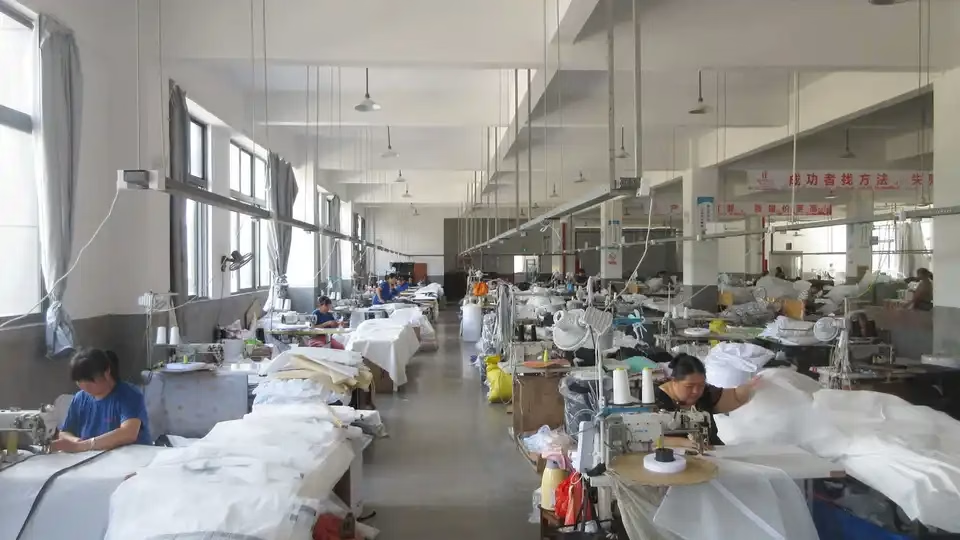
A direct manufacturer owns the full process. It buys the polyester yarn or fabric, cuts the mesh, sews the bag, and fits the zipper. Because every step happens under one roof, problems get fixed faster. Also, you can talk to the people who actually build your order.
Factory vs. Trading Company: Quick Comparison
| Factor | Direct Factory | Trading Company |
|---|---|---|
| Price | Usually lower, no middle layer | Often higher due to markup |
| Customization | Can change mesh, size, zipper, logo | Depends on its factory partner |
| Quality control | Checked on the production line | Checked after goods arrive |
| Communication | Direct to production team | Passed through a sales layer |
| Lead time control | Factory sets its own schedule | Waits on the factory’s schedule |
| Product range | Focused on its core items | Wide, but often shallow |
So how can you tell them apart? First, ask for photos or a video call of the sewing floor. Second, check the business license for “manufacturing” in its scope. Third, ask what the company makes in-house and what it outsources. A real wash bag mesh factory answers these questions without hesitation.
Beyond that, look at how long the business has run. A factory with ten or more years of steady exports has worked through raw material swings, shipping delays, and changing rules.
Where Are China’s Laundry Mesh Bag Factories Located?
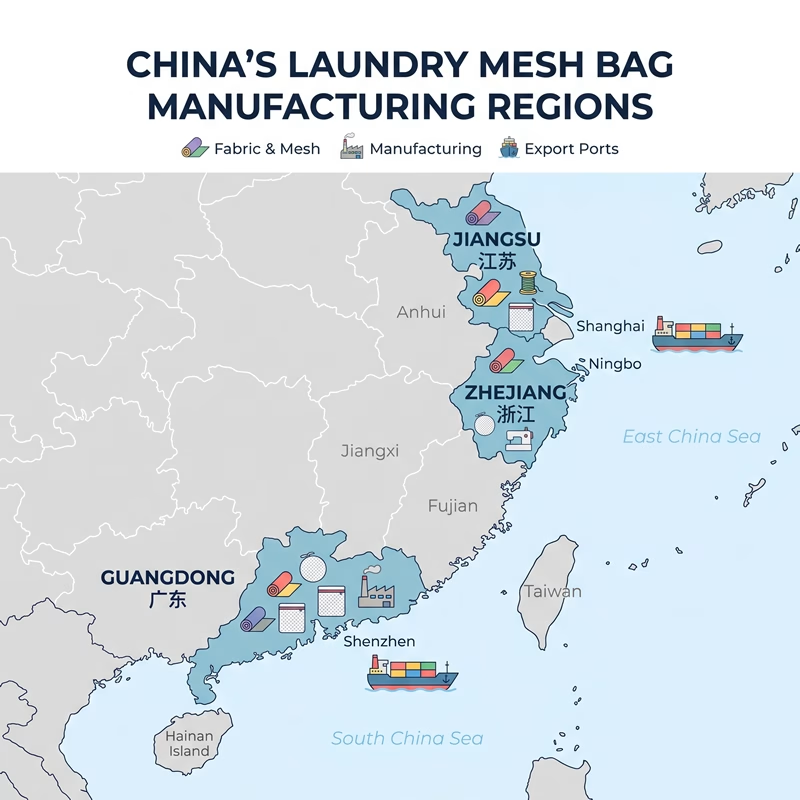
China’s textile makers sit mostly along the east coast. Zhejiang, Jiangsu, and Guangdong host many fabric mills, sewing plants, and accessory suppliers. Thanks to this clustering, factories can source mesh fabric, zippers, and packaging within a short drive.
Zhejiang stands out in particular. According to an official provincial report carried by China Daily, Zhejiang’s textile and garment industry earned 1.12 trillion yuan in 2025. That was 25.5 percent of the national total. The same report says the province’s textile exports reached $95.33 billion, or 32.4 percent of China’s total. You can read the Zhejiang textile industry report on China Daily for more detail.
Why should location affect your choice? Mainly because a full local supply chain cuts delays. When a factory can buy zippers from a nearby supplier, it can restock in days, not weeks. Port access also affects cost. Factories near Ningbo or Shanghai can move containers to Europe and North America with fewer handoffs.
That said, location alone is not proof of a good supplier. A factory in a strong cluster can still cut corners. So use region as a starting filter, then judge each supplier on its own record.
Which Mesh Bag Materials and Styles Should Buyers Compare?
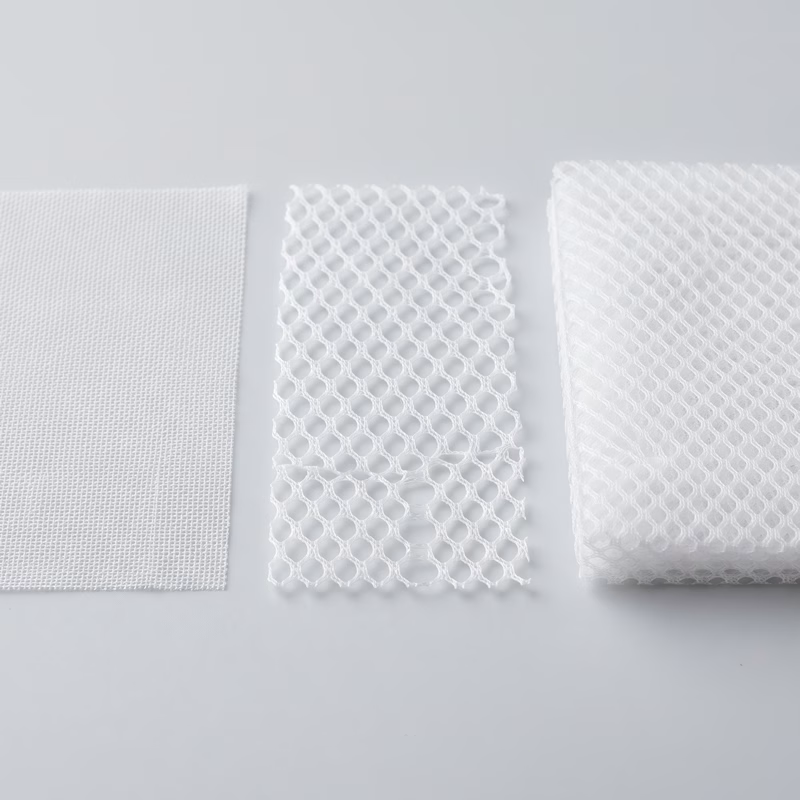
Not every mesh bag does the same job. The hole size, thickness, and layer structure change how well a bag protects clothes. So before you request quotes, decide which items your customers will wash.
Common Mesh Types at a Glance
| Mesh Type | Hole Size | Feels Like | Suits | Example |
|---|---|---|---|---|
| Fine mesh | Small | Soft, smooth | Lingerie, silk, delicate tops | Set of 7 thickened fine mesh bags |
| Coarse mesh | Large | Firm, open | Towels, jeans, bedding, sportswear | Set of 5 thickened white coarse mesh laundry bags |
| Sandwich mesh | Medium, padded | Thick, cushioned | Bras, sweaters, items that need shape support | Sandwich mesh laundry bag in Korea style |
| Thickened mesh | Small or large | Dense, durable | Frequent washing, hotel and family use | Thickened white mesh laundry bag with embroidered logo |
Most laundry mesh bags use polyester. It dries fast, holds its shape, and handles repeated machine washing. Thicker polyester mesh lasts longer, but it costs a little more per unit.
Sets, Sizes, and Closures
Retail buyers often prefer sets. A pack of three, five, or seven bags in mixed sizes gives shoppers more value on the shelf. For example, a set of 3 colorful mesh laundry bags works well for gift and home goods sections. Meanwhile, a set of 7 fine mesh laundry bags covers everything from socks to shirts. You can browse more options on the laundry bag set page.
Closures deserve close attention too. Zippers keep items secure, but a weak zipper is the most common failure point. Look for a zipper guard or a cover flap that stops the pull from snagging other clothes. The laundry bag with zipper collection shows several closure styles. For socks, baby clothes, and small items, the small laundry bag range is worth a look.
How to Vet a Wash Bag Mesh Factory in 7 Steps
A clear checking process saves money and time. Follow these steps before you sign a purchase order.
- Check the business license. Confirm the company name, founding year, and manufacturing scope. Then match the name to the bank account on the invoice.
- Request a factory tour or video call. Ask to see cutting, sewing, and packing areas. Real factories show their floor without delay.
- Order pre-production samples. Test them yourself. Wash each sample at least ten times and check the seams, zipper, and mesh shape.
- Ask for third-party test reports. For European buyers, request REACH test results for the mesh and zipper. Also check the report date and the lab name.
- Review export history. Ask which markets the factory already ships to. Experience with your region means fewer label and packaging mistakes.
- Confirm customization limits. Find out which parts can change: mesh color, size, logo method, zipper type, and packaging.
- Agree on inspection terms. Decide whether you or a third party will inspect goods before shipment. Put the inspection standard in the contract.
Each step filters out weak suppliers. For instance, a reseller may stall at step 2. A factory with poor materials may struggle at step 4. By the end, you’ll know which wash bag mesh supplier can deliver what it promises.
Red Flags to Watch For
- Prices far below every other quote
- No clear answer about who sews the bags
- Test reports that are old, blurry, or for a different product
- Pressure to pay the full amount before production starts
- Samples that look better than the specs on the quote
If you see two or more of these, slow down. Ask more questions, or move on to the next supplier.
What Compliance Tests Should Laundry Mesh Bags Pass?
Compliance protects your brand and your customers. It also keeps goods moving through customs. So ask about testing before you finalize a design.
REACH for the European Market
REACH is the European Union’s main chemical safety law. Under it, the EU restricts certain harmful substances in products, and these rules apply to imports as well as local production. For textiles, entry 72 of Annex XVII restricts 33 substances that can cause cancer, genetic damage, or harm to reproduction in clothing, textiles, and footwear. You can review the official overview on the European Commission REACH restrictions page.
For a wash bag mesh product, testing usually covers the polyester mesh, the dye, and the metal or plastic zipper parts. A good supplier will explain which parts were tested and which lab ran the test.
Other Checks Worth Requesting
| Test or Check | What It Covers | Why Buyers Ask |
|---|---|---|
| REACH substance testing | Restricted chemicals in fabric and trims | Required for EU consumer textiles |
| Colorfastness | Whether dyes bleed in the wash | Stops color transfer onto clothes |
| Zipper durability | Pull strength and cycle life | Zippers fail first on weak bags |
| Seam strength | How much force stitching can hold | Prevents splitting with heavy loads |
| Label and packaging review | Care labels, warnings, barcodes | Avoids rework at the destination |
Requirements change by market. Japan and Korea often focus on labeling and material details. North American retailers may add their own buyer tests. Therefore, share your target market early so the factory can plan the right tests.
How Do MOQ, Lead Time, and Customization Work?
Every factory sets its own terms. Still, most follow a similar pattern. Knowing that pattern helps you plan stock and budgets.
What Shapes Your Order Terms
| Term | What Affects It | What to Ask |
|---|---|---|
| MOQ (minimum order quantity) | Mesh type, custom color, logo method | “What is the MOQ per design and per color?” |
| Sample time | Stock item vs. new design | “How long for a stock sample vs. a custom sample?” |
| Bulk lead time | Order size, season, fabric stock | “When can production start after deposit?” |
| Logo options | Embroidery, printed tag, woven label | “Which logo methods do you offer in-house?” |
| Packaging | Opp bag, header card, color box | “Can you print our retail packaging?” |
MOQ tends to rise when you request a custom mesh color. That’s because the factory must dye a fresh batch of fabric. In contrast, stock colors with a custom logo usually allow smaller first orders.
Customization Options to Consider
Custom work helps your product stand out. Common options include:
- Embroidered or printed logos on the bag body, like this set of 5 thickened coarse mesh laundry bags with customized logo
- Custom colors for the mesh, zipper tape, or trim, as seen in this colorful thickened fine mesh laundry bag
- Special shapes and prints, for example a sandwich cartoon fine mesh laundry bag with embroidery
- Size sets built for your retail range, like a set of 5 thickened coarse mesh laundry bags
- Private-label packaging with your barcode and care instructions
For wholesale buyers who want a clean, classic look, a white thickened fine laundry bag is often an easy starting point. You can then add your logo and packaging on top.
Why Work Directly With a Wash Bag Mesh Manufacturer Like Us?
Established in 2014, our company is a professional manufacturer of laundry mesh bags, bra laundry bags, washing bags for shoes, storage bags, laundry baskets, and drawstring mesh. Our customers are located worldwide, with key markets in Europe, North America, South America, Korea, and Japan.
Here’s what that means for your order:
- More than ten years of focus. We have made laundry and storage mesh products since 2014. This is our core business, not a side line.
- OEM orders welcome. You can choose mesh type, size, color, logo, and packaging. Customized designs are available.
- Environment-friendly materials. Our raw materials are environment friendly, and our products can pass REACH and related tests.
- Export experience across five key regions. We already ship to the markets many buyers serve, so we know their label and packaging needs.
- A wide product range. From fine mesh sets to sandwich mesh bra bags, you can source several lines from one factory. Explore the full laundry mesh bag product range.
So when you compare suppliers, use the seven checks above on us too. We welcome factory video calls, sample requests, and test report reviews. Because we are the original manufacturer, you speak with the source, not a middle layer. That means faster answers, clearer pricing, and direct control over your wash bag mesh specs.
If you’re planning a new laundry bag line or switching suppliers, send us your target sizes, mesh type, quantity, and market. We’ll reply with a quote, sample options, and a production timeline built around your launch date. Reach out through our website, and let’s start building your order.
Frequently Asked Questions
1. What is the usual MOQ for custom mesh laundry bags?
MOQ depends on the mesh type, color, and logo method. Stock colors with a custom logo usually allow smaller orders than fully custom colors. Contact us with your design for an exact MOQ.
2. Can you add our logo to wash bag mesh products?
Yes. We offer embroidered logos, printed tags, and woven labels. We can also print your retail packaging. Send your artwork, and we’ll suggest the right method.
3. Do your laundry mesh bags pass REACH testing?
Yes. Our raw materials are environment friendly, and our products can pass REACH and related tests. Reach out for detailed test reports on the items you plan to order.
4. How long does it take to get samples?
Stock samples ship faster than custom samples, which need fresh fabric and setup. Tell us whether you need a stock or custom design, and we’ll confirm the timeline.
5. Why buy from a factory instead of a trading company?
A factory controls materials, sewing, and checks in one place. That usually means lower prices, faster fixes, and direct contact with production. Contact us to request samples and compare.