
A personalized laundry bag order needs more than a logo file. Before requesting prices, decide what the bag will carry, whether it will enter the washing machine, and whether every bag needs the same decoration. A hotel logo repeated across an order is a different specification from individual names for students or staff.
This guide compares what to specify for embroidery, printing and a possible woven label. The useful comparison is how each option handles your artwork, identification needs and bag construction. Choose through supplier confirmation and sample approval, without assuming that one method offers better wash resistance or a lower total cost.
Choose the application before the decoration
Carrying laundry and collecting wash-and-fold orders
For transport bags, describe the contents and handling route: bedroom to laundry room, customer counter to processing area, or collection point to delivery vehicle. Specify the opening, carrying arrangement and closure around that route.
Laundry-service listings include double-handle bags and large drawstring bags for wash-and-fold orders and counter sales. These are useful formats to consider when preparing a specification, but their appearance alone does not establish suitability for washing with garments inside.
Hotel collection and guest identification
Clarify whether the hotel needs a reusable collection bag, a guest-room bag or a disposable bag. Include any requirement for room identification, paperwork and separation of orders. A logo and a guest identification field serve different purposes; decide where each belongs.
In-wash protection
If the bag will enter a washing machine, state that explicitly. Ask the supplier to assess the complete construction, including decoration, closures and any attached label, against your intended care process. For material and construction questions, use the buying guide for laundry mesh bags alongside the personalization specification.
Specify names, monograms, messages or business logos
Start by separating fixed artwork from information that changes. Fixed artwork might be a hotel logo or care message. Variable information might be a person’s name, team number or department.
- Names: supply approved spelling, capitalization, accents and a rule for long names.
- Monograms: define the initial order, relative letter sizes and typeface.
- Messages: provide final wording and approved line breaks.
- Business logos: identify the approved artwork version, colors and placement.
Personalization listings show why these details matter. An embroidery offering allows selection of both wording and thread color. Another collection offers typeface and color options for personalized wording. These examples illustrate the decisions a buyer should make; they do not define this manufacturer’s available options.
For recipient-specific orders, prepare a controlled list that connects each name or number to its bag variant. Include the longest name and any unusual characters in the approval stage. A layout that looks acceptable with short initials still needs review with the actual wording.
Embroidery vs printing vs woven labels: what to compare
Embroidery: approve the lettering and its placement
An embroidery specification should cover wording, typeface, thread color, finished decoration size and position. Ask how the proposed embroidery will be supported on the selected fabric and request a view of both sides of the decorated area.
For mesh bags, have the supplier assess the proposed attachment area rather than assuming a design can be embroidered anywhere. Review the finished sample for readable lettering, fabric distortion, loose threads and the condition of the reverse side. These are acceptance checks, not evidence that embroidery performs better than another method.
Printing: identify the proposed process
“Printed logo” leaves important questions open. Ask the supplier to name the printing process proposed for your material and artwork. Define the finished graphic dimensions, colors, orientation and position relative to an agreed reference point, such as a seam.
For large graphics, review the design on the assembled bag as well as in a flat preview. Include inspection of the printed surface and an agreed care evaluation in the sample brief. Avoid treating all printing processes as interchangeable.
Woven labels: request feasibility separately
If a woven label is part of the design, ask whether the supplier can source and attach it to the chosen bag. Specify the wording or logo, finished label dimensions, fold arrangement, position and attachment method. Request a sample showing the label on the actual construction.
For an in-wash product, include the label and its attachment in the agreed care assessment. For individual names, ask how changing text would be supplied and charged. Treat woven labels as a proposed option until availability is confirmed for the order.
Compare all proposed methods against the same brief: artwork, bag material, decoration dimensions, intended care, acceptance criteria and total quoted scope. A method name alone does not establish durability, wash resistance, price or environmental performance.
Define the material, dimensions and carrying format
Material and format examples from other product offerings can help buyers describe what they want. Hotel laundry bag listings include plain-weave cotton, cotton twill, jute and nonwoven materials for logo customization. A printed knapsack-style laundry bag listing specifies fabric details and fluorescent color options. These examples are separate from this manufacturer’s stated product range.
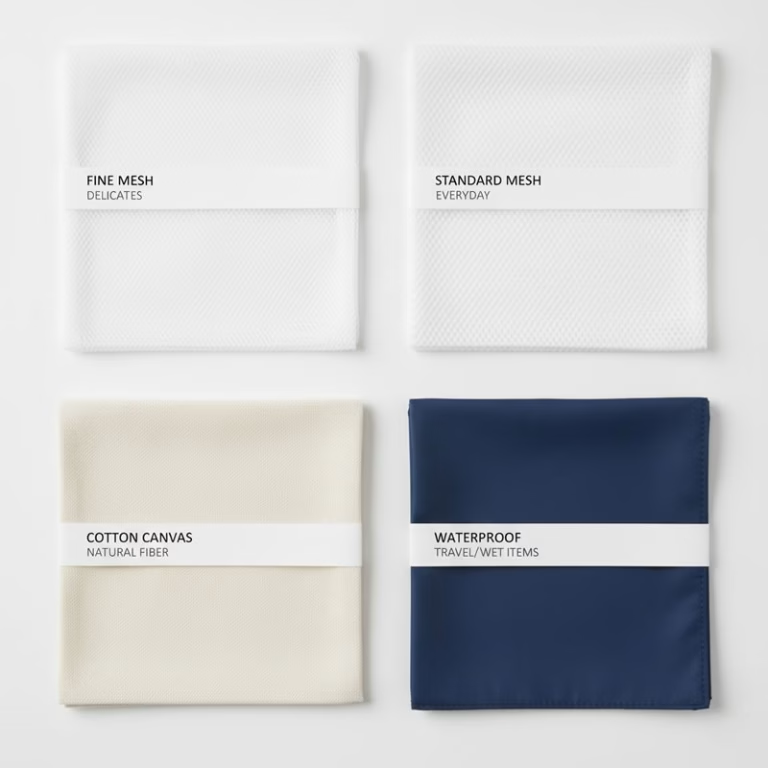
In the purchasing brief, specify the required material and construction rather than only a color and product name. Record finished bag dimensions, the usable opening, any gusset and whether measurements refer to the bag laid flat. Identify the handles, shoulder straps or drawstring arrangement required.
Mark the decoration location on a drawing. Show its relationship to seams, closures, pockets and folds. Ask for measured sample dimensions and photographs of the finished construction before approving production. Agree dimensional tolerances with the supplier instead of borrowing them from an unrelated listing.
Approve artwork and clarify every quotation charge
Separate digital approval from physical approval
A digital preview helps review spelling, layout and intended placement. It does not establish how the finished decoration looks or behaves on the selected material. A logo-customization offering describes a digital sample after artwork submission; that wording should not be read as a promise of a physical sample.
State which approvals your order requires. For a physical sample, ask the supplier to identify whether it uses the proposed production material, decoration process and construction. Review deviations before treating it as the production reference.
Compare the complete quoted scope
Published charging structures differ. A promotional bag listing separates the bag charge from plate-making and personalization charges, with an imprint area of a size that depends on the bag dimensions and artwork; confirm the available print area with our sales team. A packable travel bag listing includes personalization in its displayed price. Neither example establishes the charging structure for your order.
Ask each quotation to identify:
- The bag specification and quantity covered.
- The decoration process, size, colors and positions included.
- Artwork preparation, embroidery digitizing or printing setup charges, where applicable.
- Charges for changing names, numbers or artwork between bags.
- Digital preview and physical sample scope.
- Packing, delivery terms and any excluded charges.
Ask which charges apply again on a repeat order. For retail programs, define packing at the same time so the quotations cover the same deliverable. The guide to retail packaging for laundry bags can help structure that discussion.
Plan identification and handling features
Permanent decoration is only one way to identify a bag. A vinyl laundry bag listing includes a field for writing a name, while a custom graphic offering supports uniform-inspired designs with a different name or number for each recipient. Choose the approach around whether the bag stays with one person or moves between users.
For changing assignments, consider requesting a writable field or a pocket for a replaceable identification card. Confirm availability and suitability for the intended handling process. If paperwork travels with the bag, define the document size and how staff should access it.
A made-to-order offering includes double zippers and transparent paperwork pockets among its possible construction features. These are options to discuss in a sourcing brief, rather than capabilities to assume. For any pocket, specify whether documents are removed before washing and have the supplier assess the proposed construction accordingly.
For individually named orders, also define packing and checking rules. Decide whether bags should be grouped by department, recipient or delivery location, and how the approved name list will be matched to the packed goods.
Explore OEM mesh and hotel laundry bag options
Yiwu Yihang Daily-Use Commodity Co., Ltd. has manufactured laundry and storage products since 2014 in Shangxi Town, Yiwu, Zhejiang, China. The company accepts OEM orders and custom-design requests. Its stated markets include Europe, North America, South America, Korea and Japan.
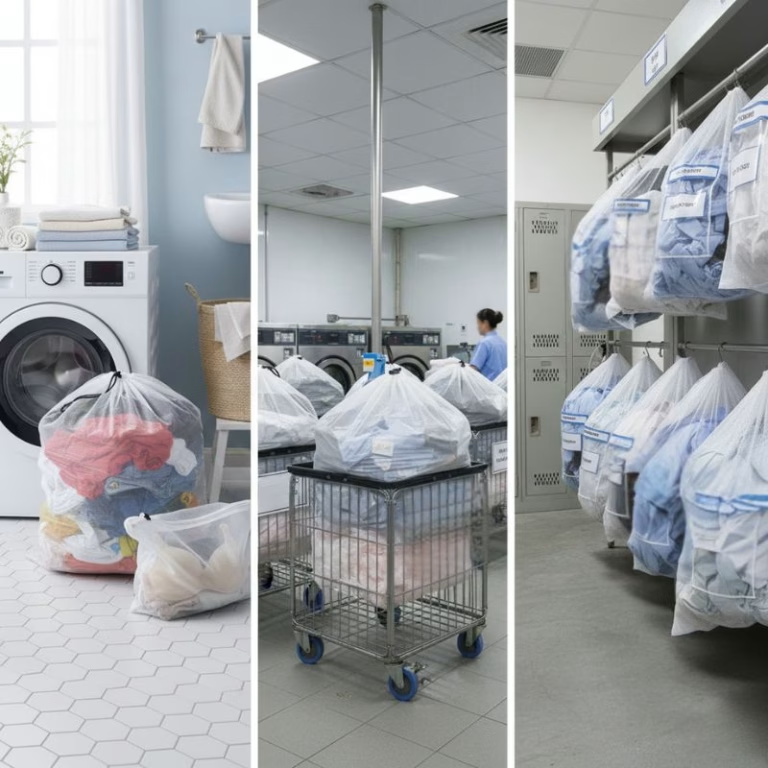
The listed range includes polyester laundry bags in fine, coarse, honeycomb, sandwich/3D and thickened mesh, alongside drawstring mesh bags and multi-piece sets. Bags with embroidery or custom logos are also listed. Discuss the selected decoration and material combination as part of the individual project.
Disposable PE drawstring laundry bags are listed for hotel and dry-cleaning applications. Keep that requirement distinct from reusable transport bags and in-wash mesh bags when preparing an inquiry.
Review the product catalog, then send a quotation request with the application, material, dimensions, construction, artwork, quantity and packing requirements. Include any recipient list and the intended care process. Request sample specifications, photographs and an itemized quotation for the exact combination proposed.
FAQ
Can mesh laundry bags go in the dryer?
Follow the care instructions for the finished bag and its contents. For a personalized bag, confirm that those instructions cover the decoration and attached components. See the guide on whether laundry bags can go in the dryer for further guidance.
Are mesh laundry bags dryer-safe?
Do not treat the word “mesh” as a dryer-safety specification. Ask for care instructions covering the exact material, closure, decoration and label combination being ordered. Include any required tumble-drying conditions in the purchasing brief.
How do you clean a laundry bag?
Empty the bag, remove loose contents and follow its care instructions. Remove paperwork from document pockets before cleaning. For reusable bags used in a laundry service, agree the cleaning process with the supplier; do not assume a disposable collection bag is washable.
Can every bag have a different name or monogram?
Request confirmation for the chosen bag and decoration method. Supply the complete recipient list, review representative layouts and ask how variable names affect artwork approval, charges, production scheduling and packing.