
A shopper zips a “dry clean only” blouse into a wash bag and runs a warm cycle. Out comes a shrunken top. The bag did its job, because the blouse was never washable. Still, the one-star review lands on the bag, and on the brand that sold it.
That gap between promise and physics is where most complaints start. Mesh wash laundry bags are simple products, but buyers often inherit vague claims like “protects everything.” They don’t. They reduce snags, tangles, and lost socks. However, they can’t change what a fabric can survive.
So here is a clear view of both sides. You’ll see five things these bags protect, five things they cannot make washable, and the specs to check before you order. You can also compare builds in our laundry mesh bag range as you read.
What Are Mesh Wash Laundry Bags, and How Do They Work?
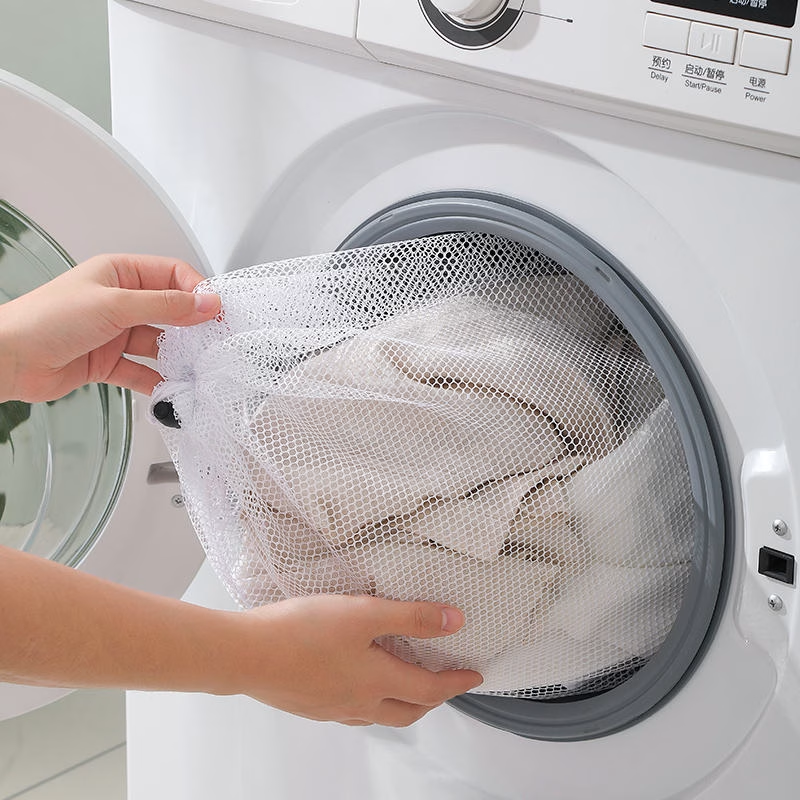
Mesh wash laundry bags are zippered or drawstring pouches made from knitted mesh fabric. Garments go inside, the bag closes, and the whole pouch goes into the washing machine. Water and detergent pass through the holes. Meanwhile, the garment stays apart from the rest of the load.
That separation is the whole idea. Inside a drum, clothes rub against each other and against metal. Hooks catch lace. Straps wrap around sleeves. Small socks slip behind the door seal. A mesh layer puts a soft wall between the item and all of that.
Three things happen inside the bag:
- Less rubbing. The garment touches smooth mesh instead of zippers, buttons, and rough denim.
- Less pulling. Straps and sleeves can’t wrap around other clothes, so they stretch less.
- Less loss. Small pieces stay together from washer to dryer to drawer.
What are they made of?
Most mesh laundry bags use polyester yarn. Polyester absorbs very little water, so the bag dries fast and stays light. It also holds color well and handles normal wash temperatures. Some bags use nylon, which feels softer but usually costs more.
However, the bag doesn’t change the wash itself. Water temperature, spin speed, and detergent still reach the fabric. Keep that point in mind, because it explains every limit covered later.
Quick answer: A mesh laundry sack is a physical barrier. It protects against contact damage. It does not protect against heat, water, or chemistry.
What Do Laundry Mesh Bags Protect? Five Jobs They Do Well
Laundry mesh bags earn their place by solving five common wash problems. Each one links to a clear cause, so each one is easy to explain on a pack or a product listing.
1. Snags from hooks, zippers, and buttons
Bra hooks and jeans zippers act like tiny claws in a spinning drum. They catch lace, knitwear, and fine jersey. Because the mesh stands between hardware and fabric, pulled threads become far less common. The bag works both ways, too. You can bag the delicate item, or bag the item with the hooks.
2. Tangling and stretching
Tights, bra straps, and long sleeves knot easily. Then the spin cycle pulls the knot tight, and the fabric stretches. A bag keeps each piece in its own space, so there is nothing to wrap around.
3. Lost and scattered small items
Baby socks, face masks, and reusable makeup pads are small enough to vanish. Some even slip into the door seal. A small laundry bag for socks and accessories keeps them together and speeds up sorting after the wash.
4. Trims, padding, and shape
Beads, sequins, and embroidery suffer when they hit the drum wall. Molded bra cups get crushed under heavy towels. A bag softens those hits. Also, a padded mesh gives more cushion than a single layer, which we cover below.
5. Surface wear on knits
Pilling starts when fibers rub loose and roll into small balls. A bag cuts the rubbing against other garments, so sweaters and activewear keep a cleaner surface for longer. It reduces pilling, but it doesn’t stop it fully.
Which garment needs which bag?
| Item | Main risk in the drum | Suggested bag |
|---|---|---|
| Lingerie and bras | Hook snags, crushed cups | Fine or sandwich mesh, small to medium |
| Tights and hosiery | Tangling, ladders | Fine mesh, small |
| Knit sweaters | Pilling, stretching | Coarse or fine mesh, large |
| Baby socks, masks, pads | Getting lost | Fine mesh, small |
| Sportswear with zippers | Snagging other clothes | Coarse mesh, medium |
| Beaded tops, if machine washable | Trim damage | Fine mesh, medium |
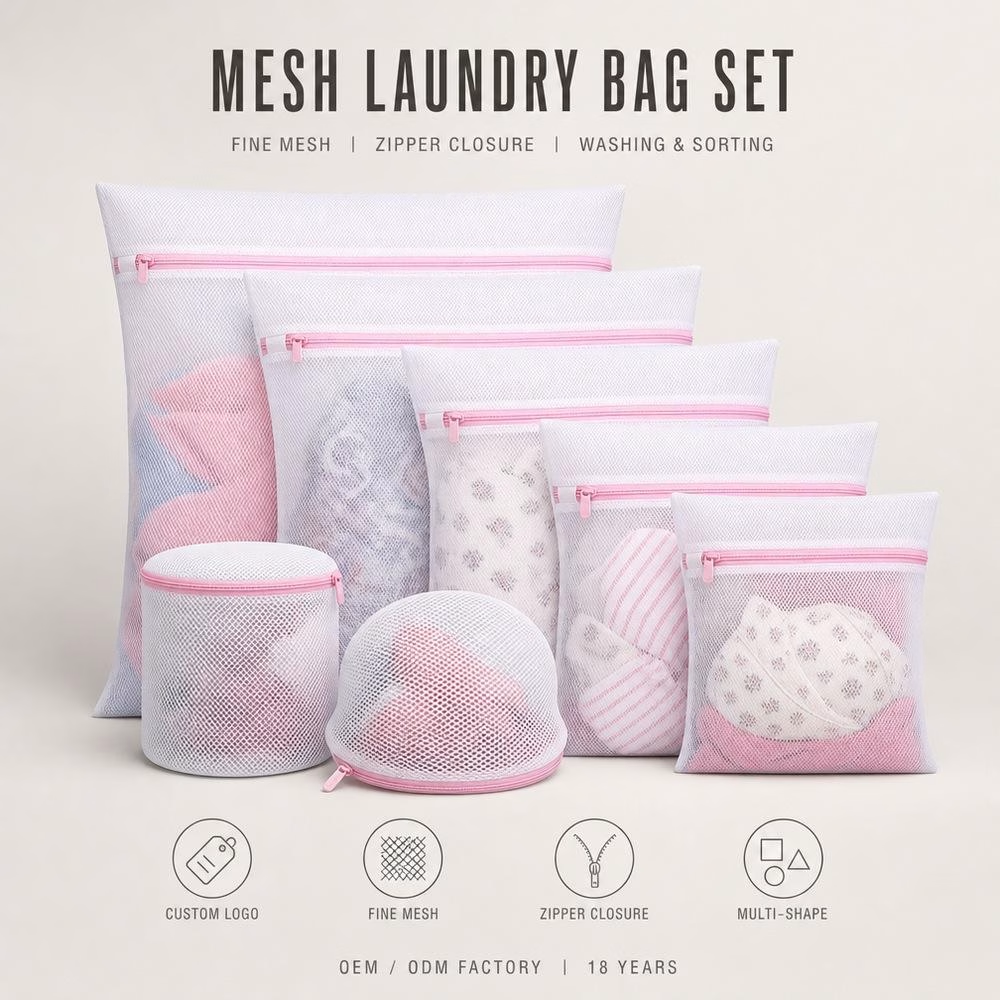
For lingerie and hosiery, a set of 7 fine mesh laundry bags covers most shapes in one pack.
What Mesh Wash Laundry Bags Cannot Make Washable
Mesh wash laundry bags protect against contact. They do nothing about heat, water, or dye. So the honest answer to “can I wash this in a bag?” always starts with the care label.
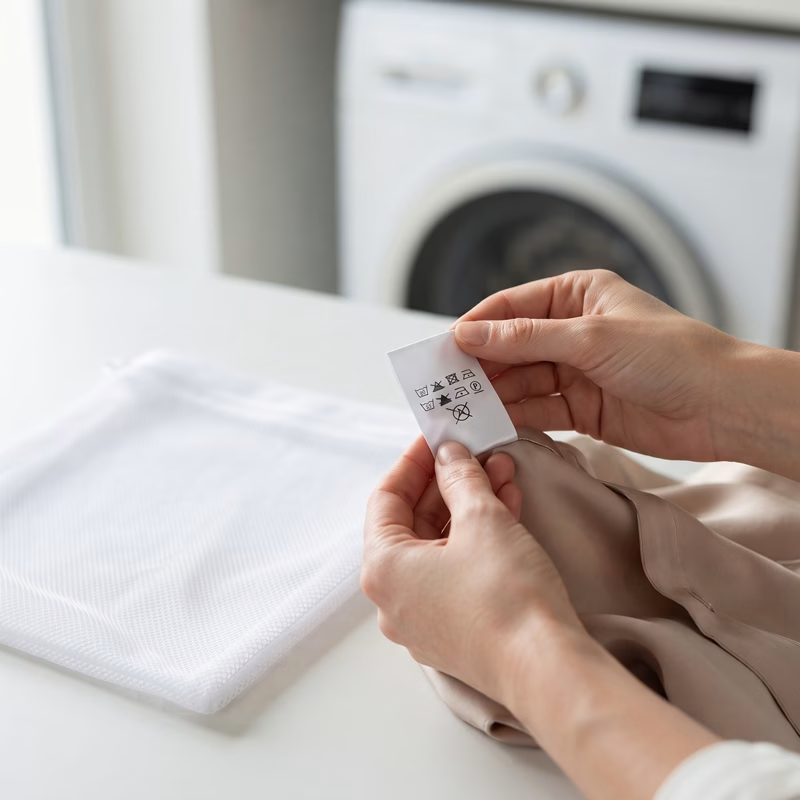
1. They don’t override the care label
“Dry clean only” still means dry clean only. The label reflects how the fiber, dye, and lining react to water. A bag changes none of that. Most markets use care symbols managed by GINETEX, and its care labeling principles explain how those symbols work.
2. They don’t stop shrinkage or felting
Wool felts when heat, water, and movement combine. Viscose can shrink, and silk can lose its sheen. Because water flows freely through mesh, the fabric still meets all three forces. A cold, gentle cycle helps. The bag alone doesn’t.
3. They don’t block color bleed
Loose dye travels in water, and water passes through every hole. A red sock in a bag will still tint a white shirt outside it. Therefore, color sorting stays necessary.
4. They can’t clean an overstuffed load
A bag packed tight is a ball of fabric. Water can’t move through it, so soil stays in and creases set hard. Fill a bag about two-thirds at most. Then the garment has room to move.
5. They can’t rescue materials that dislike water
Leather, suede, glued trims, and structured tailoring fail in water, not from rubbing. Shoulder pads lose shape, and glue lets go. No mesh fixes that.
One more honest note: a standard mesh bag is not a microfiber filter. The holes are far larger than shed fibers. Filter bags exist, but they use a much denser fabric and belong in a different product class.
Claims versus reality
| Common claim | What happens in practice |
|---|---|
| “Protects everything” | Protects against snags, tangles, and rubbing only |
| “Makes hand-wash items machine safe” | Lowers risk on a gentle cycle, but the care label still decides |
| “Stops shrinking” | No effect on heat or water |
| “Keeps colors from running” | No effect on dye transfer |
| “Fits a full load” | Works only when the bag is loosely filled |
Why should buyers care? Because clear limits on the pack mean fewer returns. A short line like “Always follow the garment care label” costs nothing, and it prevents a lot of misplaced blame.
Fine, Coarse, or Sandwich Mesh: Which Structure Fits Which Load?
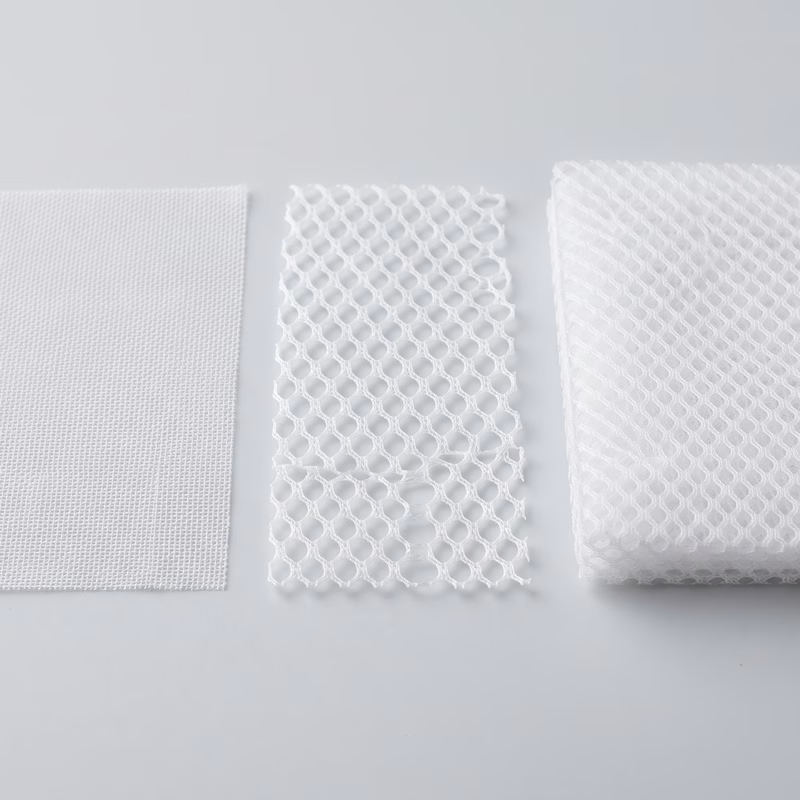
Mesh structure decides how much the bag protects and how well water gets through. There are three main structures, and each one suits a different load.
Fine mesh has small, tight holes. It gives strong surface protection, and it stops hooks from poking through. But water moves more slowly, so it suits light, delicate pieces. Our white thickened fine mesh laundry bag and the colorful thickened fine mesh laundry bag both follow this build.
Coarse mesh has larger, open holes, often in a honeycomb pattern. Water and detergent flow freely, so heavier items get properly clean. However, it gives less shielding against fine snags. A set of 5 thickened white coarse mesh laundry bags is a common pick for sweaters, shirts, and mixed everyday loads.
Sandwich mesh is a three-layer fabric. Two mesh faces hold a springy spacer layer between them. The result feels padded, so it cushions bras, trims, and shaped pieces. The Korea-style sandwich mesh laundry bag shows this structure well.
| Feature | Fine mesh | Coarse mesh | Sandwich mesh |
|---|---|---|---|
| Hole size | Small and tight | Large and open | Small, with padded layers |
| Water flow | Moderate | High | Moderate |
| Snag protection | High | Medium | High |
| Cushioning | Low | Low | High |
| Typical loads | Lingerie, hosiery, light tops | Sweaters, shirts, sportswear | Bras, embellished pieces |
| Bag drying time | Short | Shortest | Longer |
What does “thickened” mean?
“Thickened” means a heavier yarn and a denser knit than basic mesh. So the bag holds its shape, the seams resist tearing, and it lasts through more cycles. The unit price is higher, but the cost per wash can end up lower.
Which structures should a range include?
Most retail programs carry fine and coarse mesh together, because households wash both delicate and heavy items. Sandwich mesh then sits beside them as the bra and lingerie option.
How to Choose Size, Shape, and Closure
Size and closure cause more complaints than mesh type. A bag that is too small crushes the garment. And a zipper that opens mid-cycle defeats the point.
Match size to the garment
| Bag size (common market range) | Typical use |
|---|---|
| Small, about 20 × 30 cm | Socks, hosiery, baby items, masks |
| Medium, about 30 × 40 cm | Lingerie, T-shirts, light blouses |
| Large, about 40 × 50 cm | Sweaters, shirts, sportswear |
| Extra large, about 50 × 60 cm | Hoodies, pillowcases, several light items |
These sizes are common in the market, and each one can be adjusted for a custom order. Cylinder and dome shapes also exist for bras, because a flat bag can press cups out of shape.
Why sets often sell better than single bags
Households rarely wash one type of item. So a mixed laundry bag set answers the sizing question for the end user. Three formats are popular:
- A set of 3 colorful mesh laundry bags lets a family sort by color or by person.
- A set of 5 thickened coarse mesh laundry bags covers everyday loads in several sizes.
- A set of 7 thickened fine mesh bags adds small pieces for delicates.
Zipper or drawstring?
A laundry bag with zipper closure is the standard for home machines. Three details separate a reliable zipper from a risky one:
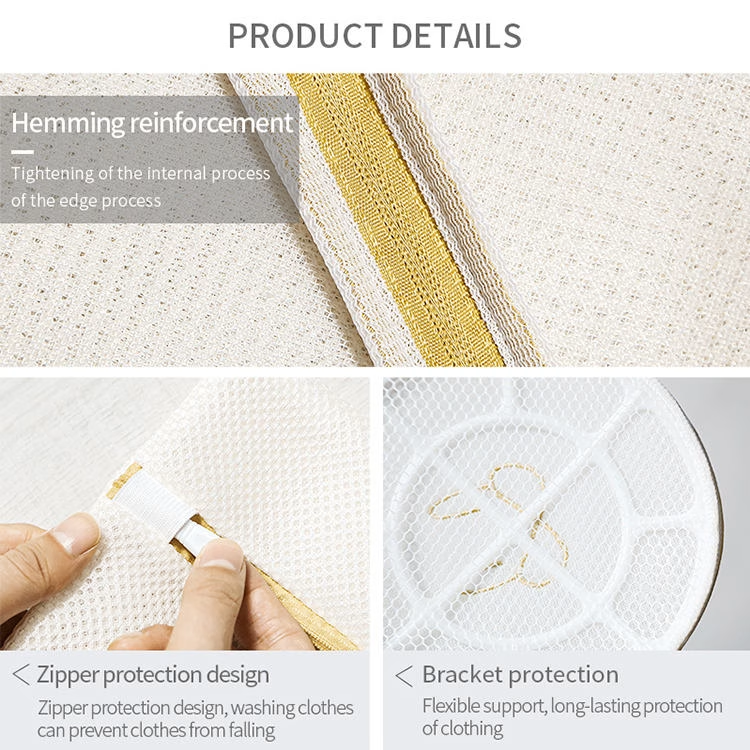
- A zipper cover. An elastic or fabric tab hides the pull, so it can’t scratch the drum or other clothes. It also stops the zipper from sliding open.
- Rust-free parts. Nylon coil zippers with plastic or coated pulls won’t stain wet fabric.
- Bound seams. A fabric tape around the edge keeps the mesh from fraying at the zipper line.
Drawstring bags close faster and hold more. Therefore, they suit laundromats, dorms, hotels, and gyms, where whole loads move in one sack. For delicates, though, a zipper gives a more secure close.
How to Use a Mesh Laundry Sack Step by Step
Correct use takes six short steps. They fit well on a pack insert, and they prevent most user errors.
- Read the care label first. If it says hand wash or dry clean only, treat the bag as extra care, not permission.
- Sort by color and weight. Keep darks, lights, and heavy items apart, just as you would without a bag.
- Fasten hooks and zippers. Close bra hooks and garment zippers before loading.
- Fill to two-thirds or less. Use one large bag per sweater, or one small bag for a few small pieces.
- Close the bag fully and tuck the pull. Slide the zipper pull under its cover.
- Choose a gentle cycle and low heat. Then remove items soon after the wash to limit creasing.
Can the bag go in the dryer?
Usually yes, on low heat, because polyester mesh handles mild warmth. But air drying is kinder to the bag and to the delicate items inside.
How do you care for the bag itself?
Wash the empty bag now and then, because lint and detergent build up in the mesh. Also check the zipper and seams, since a torn bag protects nothing.
Laundry Bags Mesh Specifications to Check Before a Bulk Order
When you compare laundry bags mesh quotes, the unit price tells only part of the story. Two bags can look the same in a photo and perform very differently by the tenth wash. So ask each supplier the same nine questions.
| Specification | What to ask | Why it counts |
|---|---|---|
| Mesh weight and yarn | What is the fabric weight in gsm? Is it polyester? | Heavier mesh lasts longer and holds shape |
| Mesh structure | Fine, coarse, or sandwich? | Sets the protection level and water flow |
| Seams | Are the edges bound with tape? | Weak seams are the first point of failure |
| Zipper | Which coil, which pull, and is there a cover? | Prevents rust marks, scratches, and openings |
| Size tolerance | What variation is allowed per size? | Keeps sets consistent across batches |
| Color fastness | Has the mesh been tested for dye transfer? | Colored bags must not stain garments |
| Chemical safety | Can you share REACH test reports? | Supports sale in the EU and many retail programs |
| Branding | Embroidery, print, woven label, or hangtag? | Affects cost, timing, and shelf appeal |
| Packaging | Polybag, header card, box, or insert? | Carries the use instructions to the end user |
What does REACH mean for a wash bag?
REACH is the European Union’s regulation on chemical substances. It restricts substances of concern in products sold in the EU. The European Chemicals Agency gives a plain overview in its guide to understanding the REACH regulation. For buyers, the practical point is clear. Ask for a recent test report from a recognized lab, and check that it matches the material you are ordering.
Which branding options work on mesh?
A logo does more than decorate, because it tells the shopper who stands behind the product. Embroidery gives a raised, lasting mark, as on our thickened white mesh laundry bag with embroidered logo. Sets can carry a brand as well, like the set of 5 thickened coarse mesh laundry bags with customized logo. For gift or lifestyle ranges, a sandwich fine mesh laundry bag with embroidery adds a softer, decorative look.
Also think about color early. White mesh reads as clean and neutral. Colored mesh helps with sorting, and it stands out on a shelf. So ask for color swatches before bulk production, and approve the shade in hand.
Which build suits which sales channel?
| Channel | What end users wash | Build that fits |
|---|---|---|
| Supermarkets and home stores | Mixed family loads | Sets of fine and coarse mesh in several sizes |
| Lingerie and fashion brands | Bras, hosiery, delicate tops | Fine or sandwich mesh with a logo |
| Baby and kids ranges | Socks, bibs, small clothes | Small fine mesh bags, colored for sorting |
| Hotels, gyms, and laundromats | Whole loads per guest or member | Large drawstring mesh sacks |
| Travel and gift ranges | A few items on the move | Compact sets with decorative embroidery |
Sourcing Directly From the Factory That Makes Them
A clear spec sheet works only if the people reading it control the production line. That is the advantage of working with the original manufacturer.
We have made laundry mesh bags since 2014. Our range also covers bra laundry bags, washing bags for shoes, storage bags, laundry baskets, and drawstring mesh. Customers buy from us across Europe, North America, South America, Korea, and Japan. OEM orders are welcome, and customized designs are available.
Our raw materials are environment friendly, and our products can pass REACH and related tests. So your compliance file starts at the source, not with a middle layer.
Because you speak with the factory, three things get easier:
- Answers come from the people who make the product. Questions about mesh weight or seam build don’t pass through a trading desk.
- Samples reflect real production. What you approve is what the line will run.
- Changes stay practical. We can tell you early if a size, color, or logo method affects cost or timing.
Are you planning a new range or reviewing a current supplier? Then send us your target sizes, mesh type, and order volume. We will reply with a quotation, sample options, and honest advice on what each bag will and won’t do for your customers. Request your quote through our website, and deal with the source from the first message.
Frequently Asked Questions
1. What is the minimum order quantity for custom bags?
The minimum order depends on mesh type, size, and logo method. Stock designs usually start lower than fully custom ones. Send us your specification, and we will confirm the exact quantity in the quotation.
2. Can you add our logo to the laundry mesh bags?
Yes, we add logos by embroidery, printing, woven label, or hangtag. Custom colors, sizes, and packaging are available too. Reach out for detailed specifications and artwork guidelines.
3. Do your mesh wash laundry bags pass REACH tests?
Yes, our products can pass REACH and related tests. Our raw materials are environment friendly. Tell us your target market, and we will share the test options that fit it.
4. How long does production take after sample approval?
Lead time depends on order volume, customization, and season. We confirm a production schedule with every quotation, so you can plan shipping dates early.
5. Can we request samples before placing a bulk order?
Yes, samples are available before bulk production. They let you check mesh weight, zipper, and stitching by hand. Contact us to request samples in the sizes you need.