
A bra comes out of the washer with a bent wire. A lace top catches on a jeans zipper. One baby sock vanishes for good. None of these problems is dramatic, but each one ends the same way for a retailer: a disappointed shopper and, often, a return.
A mesh laundry wash bag is the low-cost answer most households reach for. It is also a product that is easy to get wrong. A weak zipper or the wrong mesh can undo the whole point of the bag.
We’ve made laundry mesh bags since 2014 for customers in Europe, North America, South America, Korea, and Japan. So the notes below come from the factory floor as much as from the laundry room. You’ll find the real pros and cons, where the hype holds up, and how buyers and product teams can choose a version that earns repeat orders.
What Is a Mesh Laundry Wash Bag?
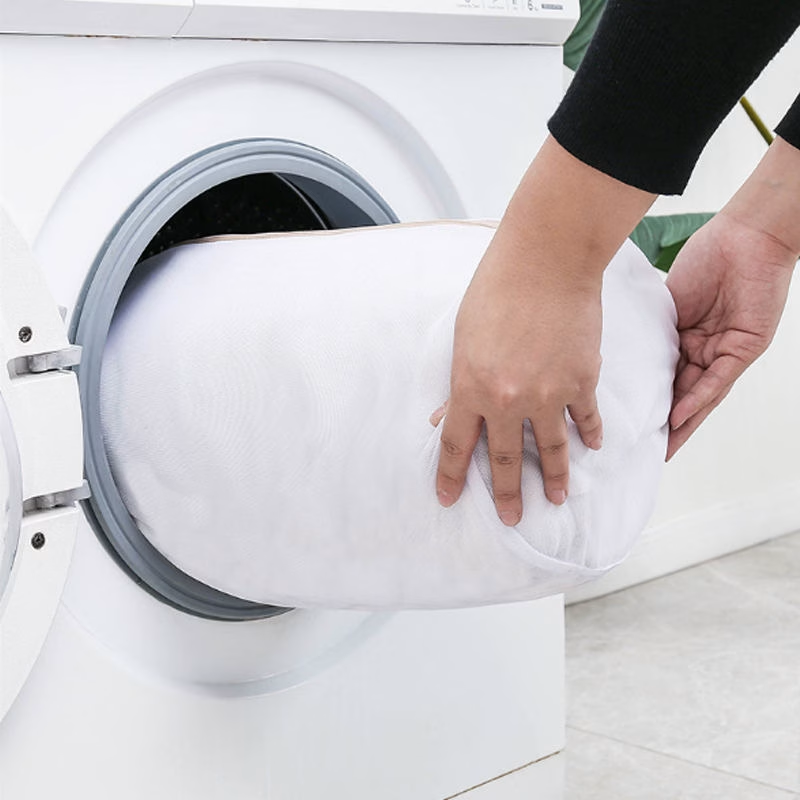
A mesh laundry wash bag is a zippered or drawstring pouch, usually made of polyester mesh, that holds garments during a machine wash. Water and detergent pass through the holes. The mesh wall keeps the items inside from rubbing, hooking, or wrapping around the rest of the load.
You may also see the product listed as a wash bag, delicates bag, lingerie bag, laundry net, or mesh laundry sack. They all describe the same basic tool.
Who buys wash bags?
Demand comes from more places than the home laundry room. Lingerie and knitwear brands bundle a bag with the garment. Hotels and laundromats use them to keep each guest’s items together. Travel retailers sell small sets for suitcases. Students carry larger drawstring versions to shared machines. Each group wants a slightly different bag, which is why the choices below deserve some thought.
Which items belong in a wash bag?
- Bras, lingerie, and hosiery
- Lace and washable fine knits
- Socks, baby clothes, and other small pieces
- Garments with hooks, ties, straps, or zippers
- Shoes and caps, in bags shaped for them
Laundry bags mesh comparison: fine, coarse, and sandwich
Most wash bags fall into three mesh groups. The right one depends on what goes inside.
| Mesh type | What it looks like | Suited to | Trade-off |
|---|---|---|---|
| Fine mesh | Small, tight holes and a soft surface | Lingerie, hosiery, lace, items with hooks or beads | Slower water flow, so garments need room inside |
| Coarse mesh | Larger open holes and strong water flow | Shirts, sweaters, everyday clothing, bulkier pieces | Hooks and thin straps can poke through |
| Sandwich mesh | Padded, multi-layer mesh that holds its form | Bras and structured items that need shape protection | Bulkier to pack and ship, with a higher unit cost |
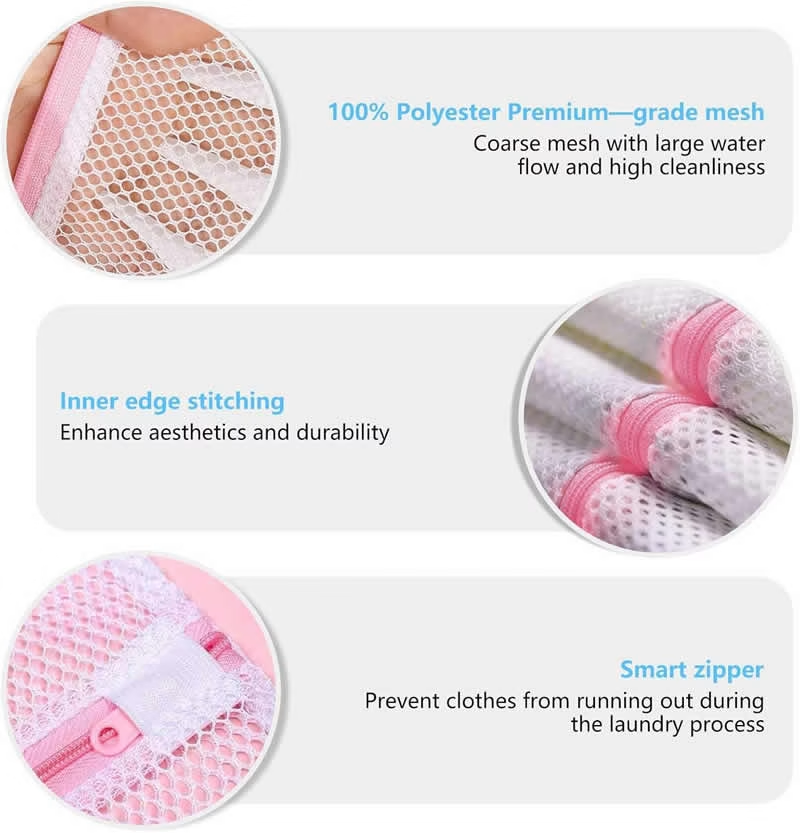
Polyester is the usual fiber for all three. It dries fast and holds its shape through repeated washing.
“Thickened” versions of fine or coarse mesh use a heavier fabric. They keep their shape longer and feel more solid in the hand, which shoppers tend to read as value.
5 Pros of a Mesh Laundry Wash Bag
The hype around wash bags is not empty. Five benefits hold up in daily use, and each one gives a product team a clear selling point.
1. Fewer snags, tangles, and stretched straps
Inside the drum, bra hooks catch lace, zippers scrape knits, and long straps wrap around other clothes. A closed bag keeps those parts away from the rest of the load.
For shoppers, that means delicate pieces last longer. For retailers, it protects the garments sold on the same shelf. A wash bag placed next to lingerie or knitwear is an easy add-on that also lowers the odds of a complaint about the garment itself.
2. Small items stay together
Socks, baby mittens, face masks, and hosiery are easy to lose in a wash. A small bag keeps pairs together from hamper to drawer. It’s a simple promise, and parents and students understand it at once.
3. Shape protection for bras and structured pieces
Molded cups and underwires take a beating in a spin cycle. A padded sandwich mesh bag cushions them and stops them from being crushed under heavier clothes. Our sandwich mesh laundry bag in Korea style is built around this use.
4. Easier sorting, storage, and travel
At home, the same bag helps you sort laundry by color or family member. When you travel, use it to keep worn clothes separate from clean ones. Between seasons, it can hold off-season clothing in a drawer. These different uses make the bag easier to market. Each one gives your content team a scene to photograph and a topic to cover, such as how to pack dirty laundry in a suitcase.
5. Low cost, light weight, and easy to brand
A wash bag is light and flat, and it won’t break in transit. Freight cost per unit stays low, and the product fits in a small retail footprint.
The surface also takes branding well. An embroidered logo, a woven label, or a custom zipper pull is enough to make it your own line. That is why wash bags work for private label, gift-with-purchase, and hotel programs. Our thickened white mesh laundry bag with embroidered logo shows how a simple logo changes the look.
4 Cons of Laundry Mesh Bags and How to Design Around Them
No honest review stops at the benefits. Wash bags draw four common complaints. Most trace back to how the bag is made or how it is used, so a buyer can deal with them at the specification stage.
1. Overfilled bags don’t clean well
Pack a bag tight and water can’t move through it. Clothes come out with detergent marks or still dirty.
The fix is part education and part range planning. Offer more than one size, and print a fill guide on the packaging. Leaving about a third of the bag empty is a sensible rule of thumb.
A set with a small, a medium, and a large bag solves much of this on its own. Shoppers can split a load across bags instead of forcing everything inside one.
2. They are not for every load
Heavy items like jeans, towels, and bedding usually wash better when they tumble freely. A bag also can’t override a care label. Hand-wash-only and dry-clean-only garments should stay out of the machine.
A bag lowers risk; it doesn’t remove it. An underwire can still bend. Clear product copy keeps shoppers from expecting too much, and that protects your reviews.
3. Zippers and seams are the weak points
This is the complaint we hear most from buyers who are changing suppliers. A zipper that rusts, splits, or slides open mid-cycle lets garments escape. Thin seam binding frays after a few washes.
Ask for three things:
- A rust-resistant zipper with a locking slider
- An elastic cover that tucks the zipper head away
- Reinforced binding along every edge
4. The wrong mesh for the garment
Coarse mesh lets bra hooks poke out. Very fine mesh, packed full, slows rinsing. Some mesh softens or loses shape under high dryer heat.
Matching the mesh to the use, and printing dryer guidance on the label, heads off most of these reviews.
| Common complaint | Likely cause | What to specify |
|---|---|---|
| Clothes not clean | Bag overfilled or too small | Several sizes, plus a fill guide on the pack |
| Zipper opened in the wash | No lock or cover on the zipper head | Locking zipper with an elastic cover |
| Bag frayed or tore | Light mesh and weak binding | Thickened mesh and reinforced seams |
| Hooks came through | Mesh too open for the item | Fine or sandwich mesh for lingerie |
| Bag lost shape in the dryer | High heat on the mesh | Low-heat guidance on the care label |
How to Choose Laundry Mesh Bags for Your Market
Choosing comes down to four decisions: mesh, size, closure, and pack format. Compliance sits behind all four.
Match the mesh to the garment
Start with what your customers wash.
- Lingerie and hosiery: fine mesh
- Everyday clothing and knitwear: coarse mesh
- Bras and structured items: sandwich mesh
If your range has room for only one option, thickened fine mesh covers the widest set of garments. Two examples are our colorful thickened fine mesh laundry bag and the white thickened fine mesh laundry bag. For a padded option with decoration, see the sandwich fine mesh laundry bag with embroidery.
Pick sizes that fit real loads
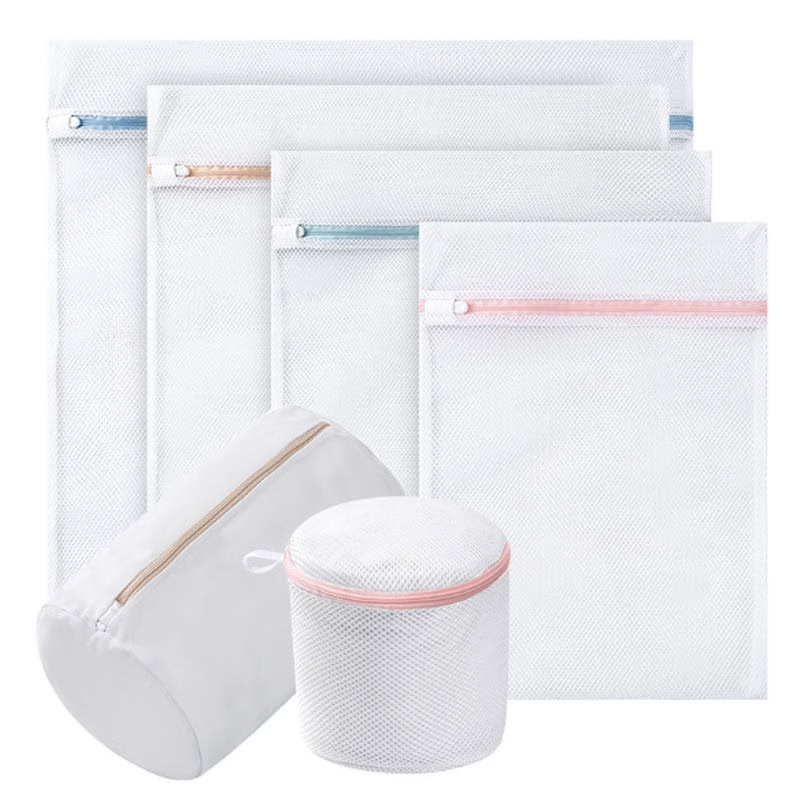
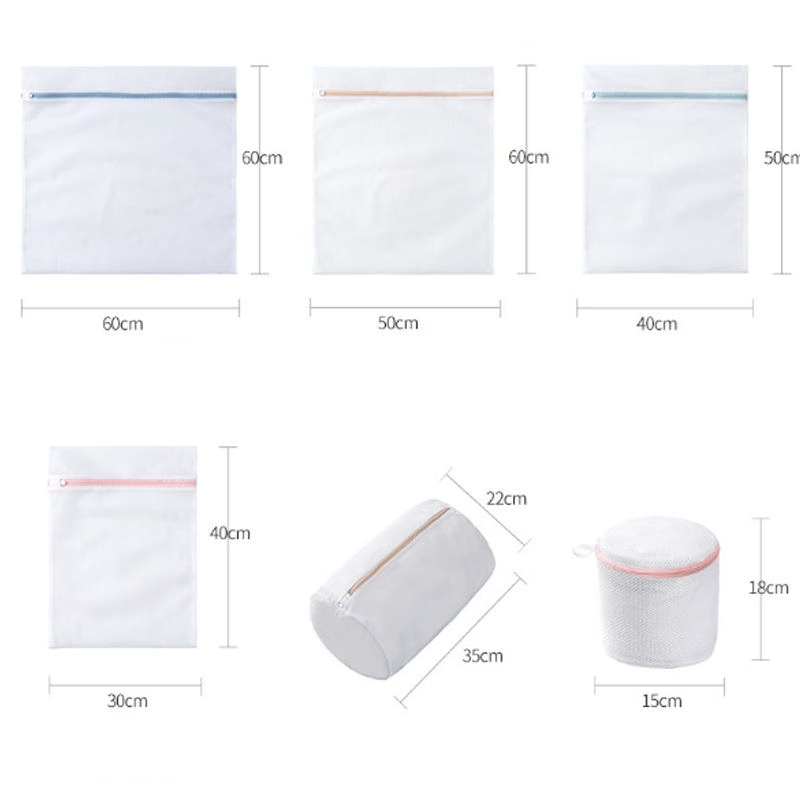
A bag that is too small gets overfilled. A bag that is too large lets a single bra slide around. The sizes below are common in the market. Treat them as a starting point, since dimensions can be made to your specification.
| Bag size (approximate) | Typical contents |
|---|---|
| Small, around 20 × 30 cm | Socks, hosiery, baby items, face masks |
| Medium, around 30 × 40 cm | Bras, lingerie, one or two blouses |
| Large, around 40 × 50 cm | Shirts and light knitwear |
| Extra large, around 50 × 60 cm | Sweaters, dresses, several garments |
Small formats sell well as add-ons and travel items. Our small laundry bag options show the shapes available.
Zipper or drawstring?
A zipper is the usual choice for bags that run through the wash cycle. It closes fully and stays flat. Browse our laundry bags with zipper closures to compare styles.
If you choose a zipper, check where it sits. A zipper along the short side keeps the opening small and the bag tidy. A zipper along the long side makes it easier to load bulky knits.
A drawstring suits larger bags used for sorting, carrying, and storage. Think dorms, gyms, and shared laundry rooms. Many buyers stock both, because they answer different needs.
Single bags or sets?
Sets raise the order value and cover several garment types in one purchase. They also photograph well for online listings.
| Pack format | Where it fits | Examples from our line |
|---|---|---|
| Single bag | Add-on sales, promotions, hotel programs | Fine, coarse, or sandwich mesh singles |
| Set of 3 | Entry price point and gifting | Set of 3 colorful mesh laundry bags |
| Set of 5 | Mixed household loads | Set of 5 thickened white coarse mesh laundry bags and the set of 5 thickened coarse mesh laundry bag set |
| Set of 7 | Value packs for online marketplaces | Set of 7 thickened fine mesh bags and the set of 7 fine mesh laundry bag set |
You can see every combination in our laundry bag set collection.
Check materials and compliance early
A wash bag touches clothing that sits against skin, so buyers in regulated markets ask about chemical safety first. In Europe, the reference point is REACH, the EU law on the registration, evaluation, authorisation, and restriction of chemicals.
The EU’s Your Europe portal has a plain-language overview of REACH chemical safety rules for importers. One point stands out for sourcing teams. Companies based outside the EU carry no direct duties under REACH, so the responsibility lands on the EU importer. That makes supplier test reports something to request before the order, not after.
Our raw materials are environment friendly, and our products can pass REACH and related tests. If your market has its own rules, tell us at the quotation stage so testing can be planned into the schedule.
How to Use a Mesh Laundry Wash Bag: Step by Step
Buyers often ask us for usage copy for packaging and product listings. The steps below follow the guidance appliance makers give. Adapt them for an insert card or a listing image.
- Sort first. Group laundry by color and fabric, as with any load.
- Prepare the garments. Fasten hooks, close zippers, and tie loose straps. Turn knits inside out.
- Choose a bag with spare room. Leave about a third of the bag empty so water can flow.
- Keep one type per bag. Don’t mix a hooked bra with fine hosiery.
- Close the bag fully. Tuck the zipper head under its cover.
- Add detergent to the dispenser or drum. Never put it inside the bag.
- Follow the care label. Pick a gentle cycle for delicates.
- Dry with care. Check the labels on both the bag and the garment. Use low heat if in doubt. Air drying is the gentlest choice.
- Empty the bag soon after the cycle. Let the bag dry before storing it.
Care tips that extend bag life
- Shake out lint after each wash.
- Check the zipper and seams every few weeks.
- Replace a bag when the mesh thins or tears, because a worn bag protects less.
These points are short enough to print on a hang tag. Good usage copy cuts down on misuse, and misuse is behind many one-star reviews.
What Should Buyers Ask a Wash Bag Manufacturer?
Two bags can look alike in a photo and perform very differently after twenty washes. These questions separate them.
Product questions
- Mesh: What is the fabric weight, and can we see fine, coarse, and sandwich samples side by side?
- Zipper: What material is it, does the slider lock, and is there a cover?
- Seams: How wide is the binding, and has the bag been wash-tested?
- Sizes: Can dimensions be changed to fit our packaging or shelf?
Branding questions
OEM orders are welcome here, and customized designs are available. Most requests fall into a few groups.
| Customization | Where it appears | Works well for |
|---|---|---|
| Embroidered logo | Bag face or corner | Retail lines and hotel programs |
| Woven or printed label | Side seam or zipper end | Private label with a clean look |
| Custom zipper color or pull | Closure | Color-coding sizes within a set |
| Mesh and binding color | Whole bag | Seasonal or brand-color ranges |
| Packaging | Header card, bag, or box | Shelf display and online shipping |
Our set of 5 thickened coarse mesh laundry bags with customized logo shows how branding carries across a full set.
Supply questions
- Are you the factory or a trading company?
- Which test reports can you share, and how recent are they?
- How long do samples take, and how long does bulk production take in peak season?
- What happens if a batch fails inspection?
A sample order is the fastest test of the answers. Run each sample through ten or more wash cycles with real garments. Then check the zipper, the seams, and the mesh surface. If the bag still looks close to new, the specification is sound.
A supplier who answers these plainly, with samples to back it up, is usually a safe pick. You can review our full range of laundry mesh bags before you start that conversation.
Is a Mesh Wash Bag Worth the Hype? Our View as the Maker
Yes, with conditions. The product does what it claims when three things line up: the mesh suits the garment, the bag has room inside, and the zipper and seams are built to last. Miss one of those and the hype fades fast, usually in the review section.
For buyers, that is good news. Every weak point is something you can specify, sample, and test before a single carton ships. A wash bag is a small item, but a well-made one earns repeat orders and supports the clothing sold beside it.
That is the work we’ve done since 2014. We are the original manufacturer of laundry mesh bags, bra laundry bags, washing bags for shoes, storage bags, laundry baskets, and drawstring mesh. When you write to us, you reach the people who cut, sew, and check the bags, with no agent in between. Questions about mesh, zippers, logos, or testing get answered at the source.
Send us your target sizes, mesh preference, and logo file. We’ll reply with a quotation, sample options, and a realistic production schedule, so you can judge the product in your own hands before you commit.
Frequently Asked Questions
1. What is the minimum order quantity for custom bags?
The minimum depends on the mesh type, size, and logo method you choose. Existing designs usually start lower than fully custom ones. Send us your specification and we’ll confirm the exact quantity with your quotation.
2. Can you put our logo on laundry mesh bags?
Yes, OEM orders are welcome and customized designs are available. Common options include embroidery, woven or printed labels, custom zipper pulls, and branded packaging. Share your artwork and we’ll suggest the method that suits your bag.
3. Do your wash bags pass REACH and related tests?
Yes. Our raw materials are environment friendly, and our products can pass REACH and related tests. Reach out for detailed specifications and testing information for your market.
4. How long does production take after sample approval?
Lead time depends on order size, customization, and the season. We confirm a production schedule with every quotation, so you can plan your launch date around it.
5. Can we request samples before placing an order?
Yes, and we encourage it. Handling the mesh, zipper, and seams yourself is the quickest way to compare options. Contact us to request samples in the mesh types and sizes you’re considering.