
When you ask a laundry bag manufacturer for a price, the accuracy of the quote depends on how complete your specification is. A tech pack is the document that tells the factory exactly what to make, how to make it, and what materials to use. For laundry mesh bags, a generic apparel tech pack often misses the points that drive cost and quality. This guide shows what a laundry bag tech pack should include so you get an accurate quote the first time.
Why Laundry Bag Tech Packs Need Different Specifications Than Apparel
Apparel tech packs focus on fit, drape, and garment construction. Laundry bags have a different set of priorities: the fabric is usually an open mesh that must survive repeated wash cycles, resist snagging, and allow water and detergent to flow through. A “polyester laundry bag” can be made from several very different mesh types, from fine lingerie net to coarse shoe-wash net. If the tech pack does not say which one, the factory has to guess. The guess may be cheaper or more expensive than you planned.
Another difference is measurement. Knit mesh stretches, so a bag cut to a certain size will measure differently under tension. Apparel tolerance methods do not work here. You need separate guidance, which we cover later in this guide. For a comparison of mesh material options, see Laundry Sack Bag Guide: Mesh vs Nylon vs Canvas Sacks.
Cover Page and Style Information: Identifying the Laundry Bag Type
The first page of the tech pack should state the product name, reference number, and a clear one-line description. At minimum, identify the broad category: drawstring mesh laundry bag, zippered bra bag, shoe wash bag, disposable PE drawstring bag, or something else. This category controls what the factory looks for next.
State the intended use: general laundry, bras and lingerie, shoes, or hotel/dry cleaner service. Intended use changes the required mesh density and bag size. For example, a bra laundry bag supplier needs fine mesh to stop hook snagging, while a shoe bag needs coarse or 3D mesh for abrasion resistance. If the cover page does not say what the bag is for, the factory will ask before quoting.
For disposable PE drawstring laundry bags used by hotels and dry cleaners, the cover page should note that the specification is for a separate product category: polyethylene film, not knitted mesh. These bags require separate fields for material weight and printing, which we explain in the bill of materials section.
Technical Flat Sketches: Showing Mesh, Drawstrings, and Closures
Include a front and back flat sketch of the bag. Do not reuse a fashion illustration. The sketch should show the bag laid flat, with all dimensions marked. A separate close-up of the mesh pattern helps the factory match the material. Even if you cannot draw a technical sketch, a clear hand-drawn diagram with labels is often enough.
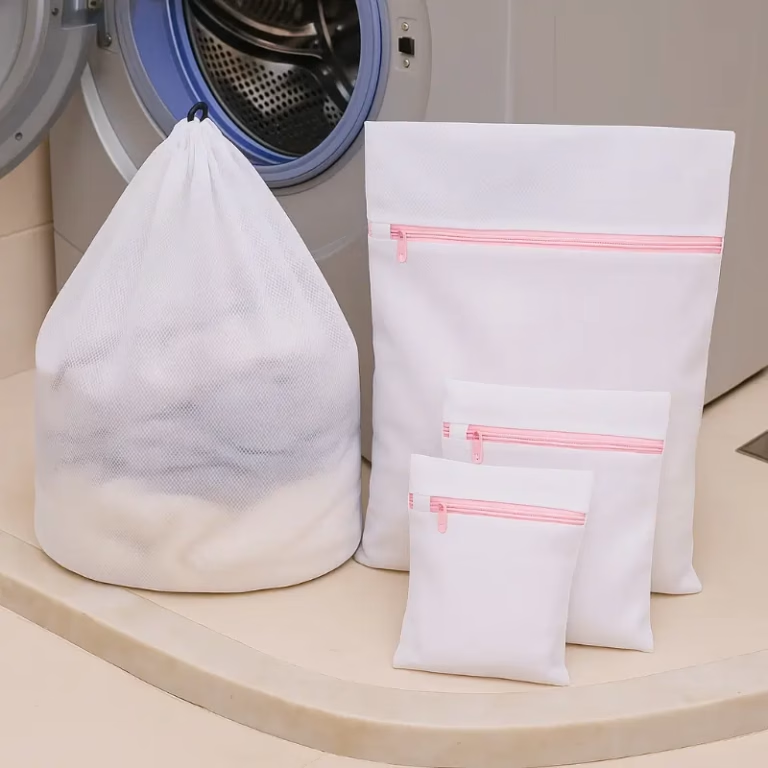
For drawstring bags, show the location of the drawstring channel, the eyelet or grommet opening, and the cord ends with toggles or knots. For zippered bags, show the zipper length, where it starts and ends, and whether there is a protective flap. If the bag has a logo or printed label, mark its position and size on the sketch. Missing these details is one of the most common reasons a sample comes back wrong.
Bill of Materials: Specifying Mesh Type, Density, and Hardware
This is the section that most affects the unit cost. List every material and component:
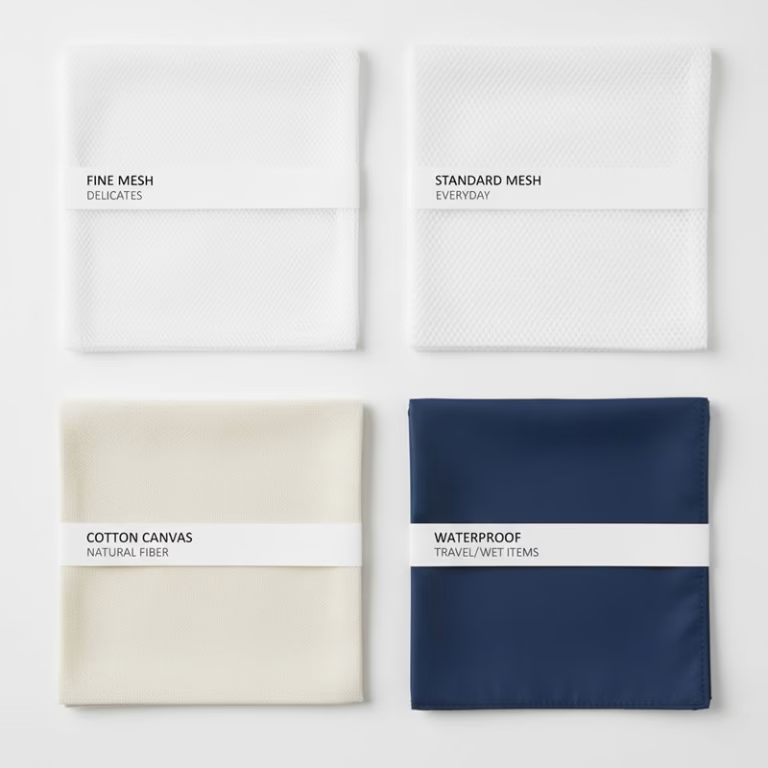
- Main body mesh: specify the exact type — fine mesh, coarse mesh, honeycomb, sandwich/3D mesh, or thickened. Do not just write “polyester mesh.”
- Binding or edge tape: material, width, and color.
- Drawcord: material, diameter, length, and tip finish (knot, heat-sealed, toggle).
- Closure hardware: drawstrings, toggles, or zippers. State size, material, color, and finish. Hardware choice changes unit cost more than many buyers expect.
- Thread: polyester or nylon, color, and seam type requirements.
- Label or logo: woven, printed, or embroidered; size and placement.
Fine mesh has small holes and is used for bras and lingerie; coarse mesh has larger holes for faster water flow and is common for general laundry; honeycomb mesh is a durable 3D knit; sandwich/3D mesh has a spacer layer for cushioning and is often used for shoe bags; thickened mesh is a heavier weight for rough use. If you know the mesh count (holes per inch) or aperture size in mm, include it. Otherwise, describe the end use and ask the factory to propose a match.
For disposable PE drawstring laundry bags, add a separate block for film thickness (in gauge or micron), material weight per bag, print colors and coverage area, and sealing method. These bags are sold to hotels and dry cleaners, and the print and film gauge drive the cost.
If your market requires chemical safety documentation, note that polyester mesh materials from this manufacturer can pass the applicable chemical safety tests, but that is not a product certificate. Always request the test report for the actual material batch before shipping.
Measurement Specifications and Tolerances for Stretchy Mesh
Measure the bag flat and relaxed. Give length and width from seam to seam, plus gusset depth if the bag has a bottom panel. For drawstring bags, include the drawcord length when fully extended and the channel width. For zippered bags, state the zipper width and the opening length.
Because mesh stretches, always state a tolerance. A common starting point is a tolerance that depends on the bag size and mesh stretch, but confirm the factory’s internal standard. If you do not specify tolerance, the factory will use its own, which may be looser than you expect. Tolerances should apply to the relaxed, unstretched measurement only.
Construction Notes: Seams, Hems, and Drawstring Channels
Tell the factory exactly how to sew the bag. Specify seam type: overlock/serger for raw mesh edges to prevent fraying, or double-stitched for stress points. Hems can be a simple turn-under or a separate binding tape. Binding tape adds durability and cost, but gives a cleaner finish.
For drawstring bags, describe the drawstring channel: is it formed by folding the top edge and stitching, or is it a separate tape sewn on? Where is the eyelet or grommet? How large? If the bag will be used for shoes, see Shoe Bag Laundry: Protect Footwear in the Washer for specific construction features that help footwear bags last.
Identify any stress points: where the cord exits the channel, where the toggle sits, and the bottom corners of a gusseted bag. These need bar tacks or extra stitching. If the bag has a zipper, specify whether it is a coil zipper or molded plastic, and whether the pull is metal or plastic. These details affect both cost and wash durability.
Cost Sheet: What Factories Need to Quote Labor and Materials
A cost sheet in the tech pack helps the factory calculate material consumption and labor. List the estimated material quantities per unit: grams of mesh, meters of binding tape, one drawcord, two toggles, and so on. You do not need to be exact; the factory will check the numbers against the flat pattern. But if you omit the cost sheet, the factory’s estimator has to build one from scratch, which adds time and may introduce errors.
Labor cost depends mostly on the number of seams and hardware insertion steps. A bag with a drawstring channel, eyelet, toggle, and logo embroidery has more labor than a simple stitched pouch. If your order quantity is low, tooling and setup costs are spread over fewer units. State your target quantity range in the tech pack cover page, not in the cost sheet, so the factory can price accordingly. Do not request a price without a quantity, because the unit price changes with volume.
The same logic applies to sample development. Incomplete tech packs lead to more sample revision rounds, which adds rework costs. A complete tech pack removes assumptions before sampling, so the first sample is closer to what you want. If you need a supplier that has manufactured laundry bags since 2014 and handles OEM orders, you can review the product range on the catalog page.
Revision History: Managing Changes Before Sampling
A tech pack is a living document. Every time you change a mesh type, a measurement, or a hardware item, record it in the revision history. Include the date, a short description of the change, and who requested it. Send the updated version to the factory and ask for acknowledgment.
When a factory receives a new version, they update their quote. If the change affects material or labor, the price may change. Without a revision log, you may end up with two teams using different versions, and the sample will not match the final quote. Keep the revision history simple: version number, date, change description.
FAQ
What is a tech pack?
A tech pack is a specification document that tells a manufacturer exactly how to produce a product. It includes flat sketches, measurements, materials, construction notes, and revision history. For laundry bags, it is the reference the factory uses to quote, sample, and build your order.
What should a laundry bag tech pack include?
At minimum, it should include the product type and intended use, flat sketches, a bill of materials with mesh type and hardware details, measurement specifications with tolerances, construction notes, a cost sheet, and a revision history. The exact format is less important than the completeness of the information.
How is a tech pack different from a spec sheet?
A spec sheet usually contains measurements only. A tech pack includes the full production picture: materials sourcing, construction methods, and revision history. A factory can quote from a spec sheet, but a tech pack removes more assumptions and reduces the chance of a wrong sample.
Who creates a tech pack?
Typically the designer or product developer creates the tech pack, but sourcing managers and brand owners can also create one. The factory reviews it, asks clarifying questions, and uses it to produce the sample. It is a collaborative document, not a one-way order form.
Do I need a tech pack for laundry bag manufacturing?
Yes, if you want an accurate quote and a sample that matches your expectations. A simple laundry bag may not need a 20-page tech pack, but a one-page summary with mesh type, hardware, measurements, and construction notes is much better than an email description. Without it, the factory works from assumptions, and you may pay for those assumptions in sample revisions.
If you are new to mesh laundry bags, start by understanding why they are used: Why Do We Need To Use A Mesh Laundry Bag? can help you define the product before writing the tech pack.