
Using one very large mesh bag for an entire load sounds convenient. You could collect your clothes, close the zipper, wash everything, move the bag to the dryer, and avoid sorting individual items. However, large mesh laundry bags for delicates work best when they protect selected garments—not when they are packed with every piece of clothing in the laundry basket.
An overfilled bag restricts movement, reduces water flow, and may prevent detergent from reaching every garment evenly. It can also leave clothes tangled, poorly rinsed, or damp after drying. The better approach is to use one large bag for a few compatible items or divide the load among several appropriately sized bags.
This guide explains how to choose, fill, wash, and dry with mesh laundry bags without sacrificing cleaning performance.
Can Large Mesh Laundry Bags for Delicates Hold a Full Load?
Yes, you can buy an oversized mesh bag capable of holding many garments. Still, physical capacity and useful washing capacity are not the same thing.
A bag may have enough space for ten shirts when they are dry. Once the garments absorb water, however, they become heavier and need room to move. If the clothes form a dense bundle, water and detergent may circulate around the outside without properly reaching the garments in the center.
Therefore, large mesh laundry bags for delicates should not normally be treated as closed laundry hampers that go directly into the machine while completely full. They are protective washing tools. Their purpose is to reduce stretching, snagging, tangling, and contact with rougher items.
One large bag may work for:
- One lightweight sweater
- Two or three delicate tops
- A few pieces of soft lingerie
- Several thin scarves
- One delicate dress, depending on its fabric
- A matching set that requires the same care cycle
It is less suitable for a mixed load containing jeans, towels, delicate underwear, cotton shirts, and knitwear. These items have different weights, drying times, and care requirements.
For broader product selection, review the available laundry mesh bag sizes and designs.
Why One Oversized Bag May Reduce Washing Performance
Laundry needs space to move. Movement helps water, detergent, and mechanical action reach the fabric. When every garment is compressed inside one oversized mesh wash bag for clothes, several problems may appear.
Restricted water and detergent flow
Mesh allows water to pass through, but it cannot guarantee that water will move evenly between tightly packed layers. A dense bundle of wet fabric creates its own barrier.
Fine mesh provides strong protection against hooks and rough surfaces. Nevertheless, it may require more free space inside the bag because its openings are smaller. Coarse mesh provides faster water movement, although it offers less protection from small hooks or sharp decorations.
Limited mechanical action
A washer cleans through a combination of water, detergent, time, temperature, and movement. Clothing inside a loosely filled bag can shift and flex. Clothing inside a packed bag may rotate as one heavy mass.
Consequently, collars, cuffs, underarms, and stained areas may not receive enough cleaning action. Folding a stained section into the center of a packed bag can make the problem worse.
Poorer rinsing
Detergent and loosened soil must leave the fabric during the rinse cycle. A crowded bag can trap suds between garments. This may lead to:
- Detergent residue
- Stiff or uncomfortable fabric
- Remaining odors
- Visible marks on dark clothing
- The need for an additional rinse
Load imbalance
One heavy bag can collect on one side of the drum, especially during spinning. That uneven weight may cause vibration, noise, or an interrupted spin cycle. The risk depends on the washer type, drum size, bag dimensions, and weight of the wet garments.
Using two or three balanced bags is often more practical than placing the entire delicate load in one bag. The bags can move separately and distribute their weight more evenly.
Mixed garments still require sorting
A mesh bag does not make incompatible garments compatible. Whites can still be affected by loose dye. Delicate fabric may still be damaged by the wrong temperature, detergent, or cycle. Heavy cotton also dries more slowly than thin synthetic fabric.
The American Cleaning Institute’s laundry guidance recommends sorting garments by color, fabric, soil level, and care instructions. It also notes that mixing small and large pieces can improve movement within a normal load.
For this reason, large mesh laundry bags for delicates should support a good sorting process rather than replace it.
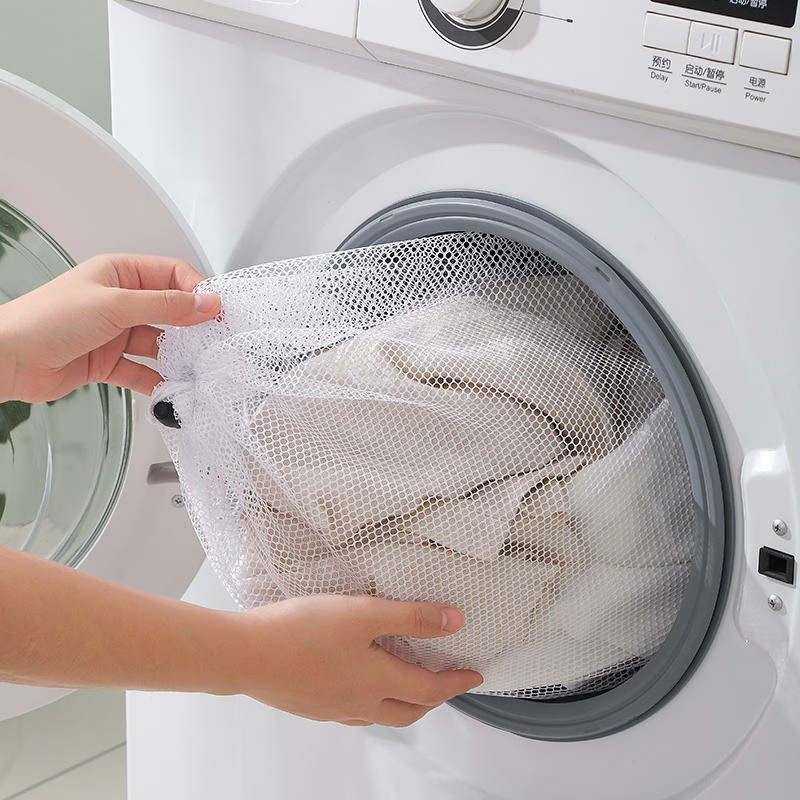
When Are Large Mesh Laundry Bags for Delicates Useful?
A large bag is useful when the garment itself needs room. The key is choosing a bag because of the item’s dimensions—not because you want to force an entire laundry load into one container.
Sweaters and knitwear
A washing machine bag for sweaters can reduce direct rubbing against the drum and other clothes. It may also prevent sleeves from wrapping around smaller items.
First, fold the sweater loosely. Then place it inside a bag with enough unused space for water movement. Always check whether the care label permits machine washing. Some wool, cashmere, or structured knitwear may require hand washing or professional cleaning.
Delicate dresses and blouses
Long straps, thin sleeves, lace panels, and decorative details can become tangled. A large delicates wash bag helps keep the garment contained. However, beads, metal decorations, and glued trim may still require special care.
Lightweight activewear
Mesh bags can separate thin performance garments from towels, jeans, and clothing with hook-and-loop fasteners. Because activewear is often made from synthetic fibers, it should be washed according to its care label and kept away from damaging heat.
Baby garments and matching sets
Small garments can disappear inside larger items or collect around the washer seal. One or more reusable garment protection wash bags keep matching pieces together while still allowing them to move.
Travel and shared laundry rooms
Travelers can organize clean and used clothing in separate bags. Before washing, however, a storage bag should be checked to confirm it was designed for machine use. A drawstring packing bag is not automatically a wash bag.
For coordinated sizes, a set of seven thickened fine-mesh bags offers more sorting flexibility than one fully packed bag.
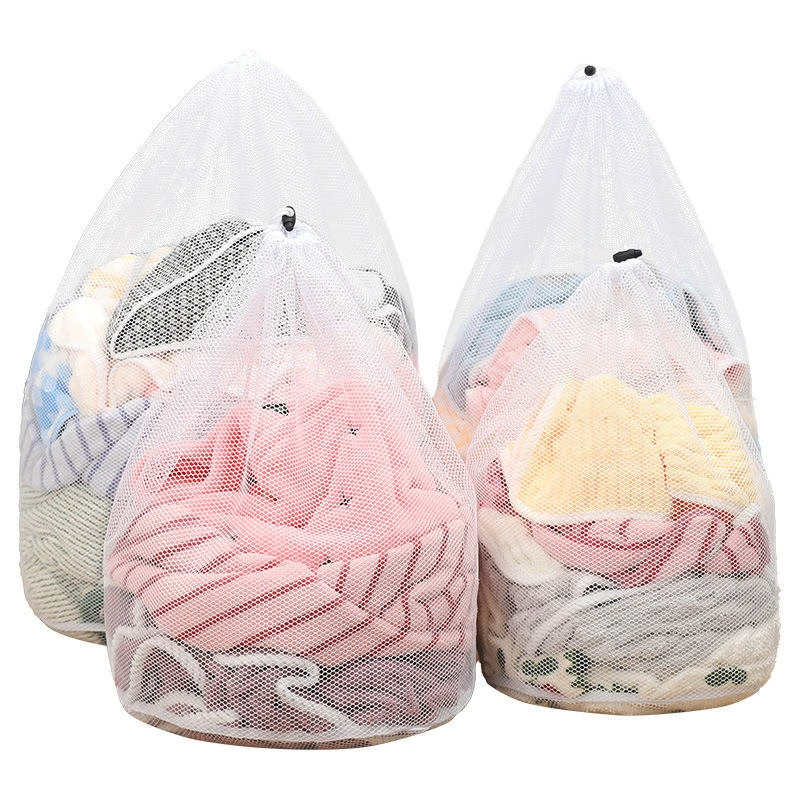
When large mesh laundry bags for delicates make sense
A larger bag has a clear role in a well-planned product range. It gives users a way to protect multiple small garments in one wash cycle, reduce lost socks, and keep lightweight pieces together. It also appeals to households, dormitory users, travel customers, and people who wash several lingerie items at once.
The key is to define the product’s intended use correctly. A large bag is suitable for a small group of related garments, not an entire family laundry load.
For retail assortments, a single oversized laundry mesh bag may sell well as an individual item. Still, a set often offers more practical value because customers can separate fabrics rather than overfill one bag. A set of 3 colorful mesh laundry bags is useful for basic sorting, while a laundry bag set with multiple size options supports more detailed garment care routines.
From a sourcing perspective, assortment packs can also make product positioning clearer. The package can show which bag is intended for bras, fine garments, socks, sweaters, or travel storage.
How Full Should Large Mesh Laundry Bags for Delicates Be?
As a practical rule, fill a mesh bag to roughly one-half or two-thirds of its usable volume. The correct limit depends on the garment’s thickness, the mesh structure, and the washer.
The bag should pass a simple movement test:
- Place the garments inside without compressing them.
- Close the zipper or drawstring.
- Lift and gently turn the bag.
- Check whether the garments can shift independently.
- Confirm that the mesh is not stretched tightly around the contents.
If the bag feels like a hard pillow, it is too full. If the clothes can move and the mesh remains relaxed, the fill level is more suitable.
Choose capacity by garment bulk
Item count is not a reliable measure. Five thin undergarments may occupy less space than one thick sweater. Likewise, two lightweight blouses may wash comfortably together, while two heavy knitted garments may create an unbalanced bundle.
| Bag use | Recommended contents | Practical fill level |
|---|---|---|
| Small bag | Socks, underwear, or one bra | About one-half full |
| Medium bag | One blouse or several light pieces | One-half to two-thirds full |
| Large bag | Sweater, dress, or several thin tops | About one-half full |
| Extra-large bag | Bulky but washable delicate item | Enough empty space for movement |
| Multiple-bag load | Delicates sorted by color and weight | Balance bags around the drum |
Do not select an extra-large zipper laundry bag based only on its outside measurements. Consider its depth, seam construction, closure position, and the amount of space remaining after the garment is inserted.
For example, the Korean-style sandwich mesh laundry bag is listed in several dimensions, including 30 × 40 cm, 40 × 50 cm, and 50 × 60 cm. A size range like this allows users to match each bag more closely to the garment.
How to Wash Clothes in Large Mesh Laundry Bags for Delicates
The following process protects garments while preserving cleaning performance.
1. Read every garment care label
Check the permitted water temperature, washing method, cycle, bleach instructions, and drying method. A laundry bag cannot protect a garment from an unsuitable temperature or cycle.
“Dry clean only” does not become “machine washable” because the garment is inside a bag. Similarly, a hand-wash label should not be ignored unless the garment supplier gives clear alternative instructions.
2. Sort by color, fabric, and soil level
Separate whites, light colors, dark colors, and items that may release dye. Keep heavily soiled clothing away from lightly worn delicates.
Also separate heavy and light fabrics. Jeans, bath towels, jackets, and thick cotton items can create friction and affect load balance. Delicate items usually perform better in a dedicated gentle load.
3. Check every pocket and fastening
Remove coins, keys, paper, and other objects. Close garment zippers so their teeth do not rub against nearby fabric. Fasten hooks when the garment-care instructions support doing so.
For bras, close the hooks and place the item in an appropriately shaped bag. Loose hooks may catch the mesh or another garment.
4. Treat stains before bagging
Apply a suitable treatment to stained areas before placing the garment in the bag. Follow the stain-remover instructions and test colorfastness in an inconspicuous area when necessary.
Do not fold the treated area deep inside a crowded bundle. Keep the garment loose so water can reach the stain.
5. Select the correct mesh and bag size
Fine mesh is generally suitable for lace, underwear, delicate knit structures, and clothing with small hooks. Coarse mesh can provide greater water flow for less fragile items. Sandwich or padded mesh adds structure and may reduce direct impact.
A thickened white mesh bag with an embroidered logo may suit organized programs that need greater fabric weight and product identification. For size-based sorting, consider a set of three colorful mesh laundry bags.
6. Load the bag loosely
Place the garments flat or loosely folded. Do not roll them into a hard bundle. Leave approximately one-third to one-half of the bag empty, depending on garment thickness.
When using several bags, mix their sizes around the drum. Avoid putting one heavy bag on one side and several very light items on the other.
7. Secure the closure
A zipper should close smoothly without pulling against tightly packed fabric. If the design has a zipper cover, place the slider beneath it. This helps reduce contact between the zipper pull and the drum.
With a drawstring bag, secure the cord as instructed. Long, loose cords may wrap around other items, so the closure design must be suitable for machine washing.
You can explore additional laundry bags with zipper closures when comparing closure options.
8. Choose a compatible wash cycle
Use the temperature, spin speed, and cycle permitted by the garment labels. A delicate or gentle cycle usually reduces mechanical action, but machine settings vary.
Use the correct amount of detergent for the load, water hardness, soil level, and washer type. Excess detergent does not correct poor water flow inside an overfilled bag. Instead, it can make rinsing more difficult.
9. Inspect the garments after washing
Open the bag and check whether the garments are clean and evenly rinsed. If they still feel soapy, use an additional rinse rather than applying high heat.
Reshape knits and other delicate garments while damp. This is also the right time to separate items that require different drying methods.
Can the Same Mesh Bag Go Into the Dryer?
Sometimes—but only when both the bag and every garment inside are approved for the chosen drying method and temperature.
Do not assume that a machine-washable bag is automatically suitable for tumble drying. Mesh material, zipper components, elastic sections, coatings, printed logos, and decorative parts can have different heat limits.
More importantly, the garments may have conflicting drying requirements. A synthetic sports top may permit low-temperature tumble drying, while a lace item or knitted sweater may need to air-dry.
Why a packed bag dries poorly
Dryers depend on airflow and tumbling. When wet clothing remains compressed inside one closed bag:
- Interior garments receive less airflow.
- Moisture becomes trapped between fabric layers.
- The outside may feel dry while the center remains damp.
- The cycle may take longer.
- Heat exposure may become uneven.
- Wrinkling can increase.
The U.S. Department of Energy recommends separating heavier cottons from lightweight clothing, avoiding over-drying, and air-drying fabrics when recommended by clothing manufacturers.
A safer drying process
After washing:
- Remove the garments from the bag.
- Read each care label again.
- Separate air-dry items from tumble-dry items.
- Reshape sweaters and knitted pieces.
- Dry lightweight and heavy garments separately.
- If using the bag in a dryer, confirm its temperature rating first.
- Use the lowest suitable temperature and inspect the load promptly.
In most cases, the bag provides its greatest benefit during washing. Removing the clothes before drying improves airflow and makes it easier to follow each garment’s instructions.
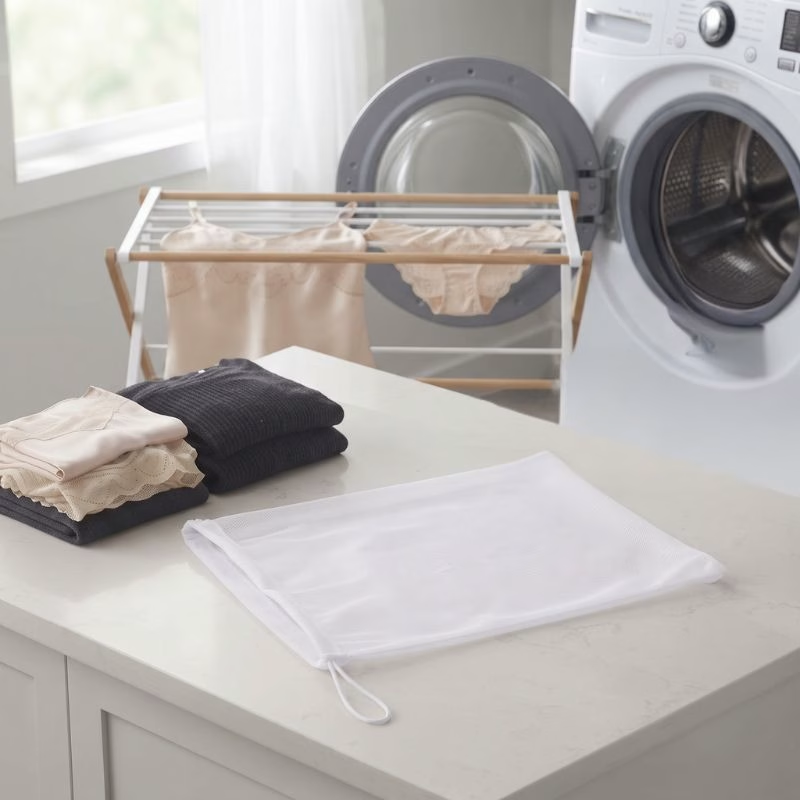
Choosing Large Mesh Laundry Bags for Delicates
The most suitable product depends on the garment, the washing process, and the intended sales market. Buyers should evaluate more than dimensions and price.
Fine, coarse, or sandwich mesh
| Mesh construction | Suitable uses | Main consideration |
|---|---|---|
| Fine mesh | Lace, underwear, hosiery, thin knitwear | Strong containment with slower water movement |
| Coarse mesh | Shirts, light sportswear, general garments | Greater water flow with less protection from hooks |
| Sandwich mesh | Structured garments and organized sets | Added body and cushioning, depending on construction |
| Thickened mesh | Repeated household or commercial use | Confirm fabric weight, seam quality, and drying limits |
Fine-mesh products, such as a set of seven fine mesh laundry bags, support sorting by item size. Coarser options, including a set of five thickened coarse-mesh bags, may suit garments that need stronger circulation.
Examine the seams
The seams carry the wet weight of the clothing. Buyers should inspect:
- Stitch density and consistency
- Reinforcement at closure points
- Loose thread control
- Seam allowance
- Resistance to repeated washing
- Shape retention after use
A large bag experiences greater force than a small bag because it can hold more wet fabric. Therefore, simply increasing the dimensions without strengthening the seams may reduce useful product life.
Evaluate the zipper system
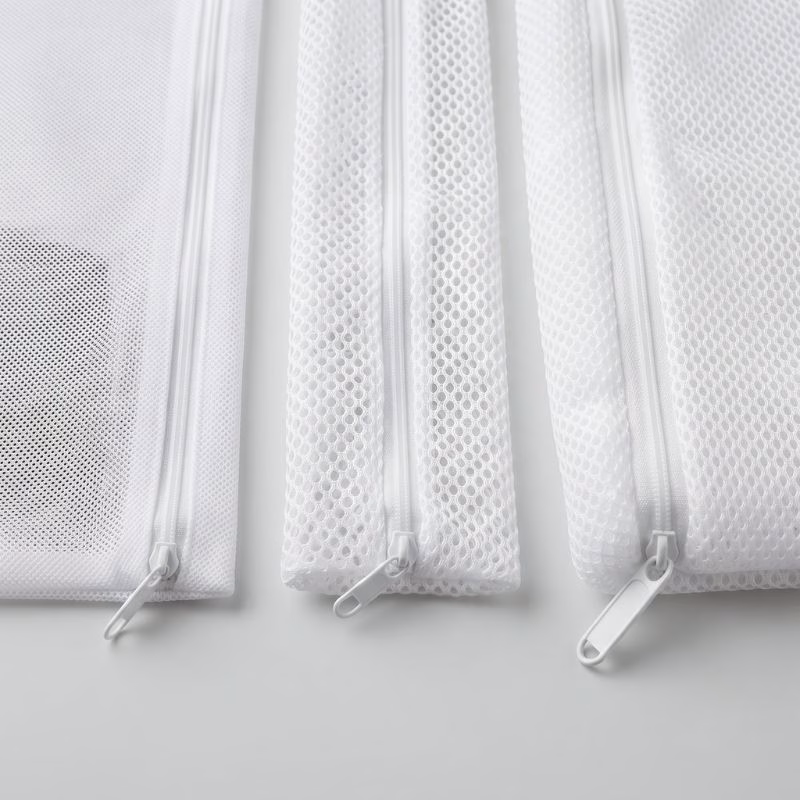
A suitable zipper should move smoothly, remain closed during washing, and resist corrosion under the intended conditions. A zipper cover can help keep the slider away from the drum and other garments.
The puller should be easy to operate without becoming bulky. Buyers should also evaluate whether the zipper tape shrinks or twists after repeated washing.
Match the bag to the washer
A very large bag may be suitable for a commercial-size drum but unsuitable for a compact household washer. The filled bag must have enough room to move without becoming trapped against the door seal or agitator.
Product specifications should clearly state the flat dimensions. Where possible, usage guidance should also describe suitable garment types and recommended fill levels.
Prefer sets when sorting adds value
A single large delicates wash bag may suit one sweater or dress. However, sets provide more flexibility for households, hotels, care facilities, sports programs, and organized laundry services.
A laundry bag set can separate:
- Light and dark delicates
- Underwear and outerwear
- Adult and child garments
- Fine and coarse fabrics
- Personal items belonging to different users
Smaller items can also be placed in a dedicated small laundry bag instead of disappearing inside a large bag.
Consider color and identification
Colored trim helps users recognize sizes or garment groups. Embroidery and printed logos can support retail presentation, hospitality operations, institutional sorting, or private-label programs.
However, colorfastness and decoration durability should be tested under the intended washing conditions. Logo placement should not weaken the mesh or obstruct water movement.
What Should Professional Buyers Ask a Manufacturer?
Product appearance is only one part of sourcing. Procurement teams and product managers should confirm whether the bag construction matches the intended washing method, garment type, market, and expected service life.
Define the intended use
A useful product brief should explain:
- Garments the bag will hold
- Expected dry and wet load weight
- Required bag dimensions
- Preferred mesh opening and fabric weight
- Washer and dryer conditions
- Target number of wash cycles
- Closure preference
- Packaging format
- Logo and color requirements
- Applicable testing or documentation
This information helps prevent an unsuitable product from being selected simply because it is labeled “large.”
Request physical samples
A sample allows the buyer to check the zipper, seams, mesh feel, dimensions, color, and workmanship. More importantly, it can be tested with the actual garments and equipment used by the target customer.
A practical sample test should include:
- Measuring the unused bag.
- Loading it to the proposed capacity.
- Running the intended wash cycle.
- Checking closure security and seam movement.
- Measuring the bag again after drying.
- Inspecting the mesh, zipper, logo, and garment.
- Repeating the test to evaluate durability.
Contact the manufacturer to request samples of shortlisted designs before approving bulk production.
Confirm customization details
OEM and custom projects may include:
- Custom dimensions
- Fine, coarse, or sandwich mesh
- Custom fabric weight
- Colored zipper tape or trim
- Printed or embroidered logos
- Care labels and warning labels
- Retail packaging
- Multipiece sets
- Barcode and carton requirements
For branded multipacks, buyers can review a set of five coarse-mesh bags with a customized logo as a reference.
Discuss testing early
Our materials are environmentally conscious, and products can be prepared to pass REACH and related tests. Nevertheless, testing scope, test method, laboratory, report validity, and covered materials should be confirmed for each order.
Buyers should specify the destination market and any restricted-substance, labeling, packaging, colorfastness, dimensional-stability, or durability requirements. Existing reports should be checked to ensure they cover the exact material and components being purchased.
Compare total value
The lowest unit price may not provide the lowest total cost. A bag that opens during washing, loses shape, or requires frequent replacement can create complaints and returns.
Compare suppliers using measurable points:
- Material specification
- Usable dimensions
- Seam and zipper construction
- Sample performance
- Customization capability
- Quality-control process
- Testing support
- Packaging accuracy
- Lead-time reliability
- Communication during production
Since 2014, we have manufactured laundry mesh bags, bra laundry bags, shoe-washing bags, storage bags, laundry baskets, and drawstring mesh products for customers across Europe, North America, South America, Korea, Japan, and other markets.
One Large Bag or Several Smaller Bags?
For most laundry routines, several appropriately sized bags are more effective than one completely filled bag.
| Decision factor | One overfilled bag | Several suitable bags |
|---|---|---|
| Water circulation | Restricted in the center | More even around garments |
| Garment movement | Clothes move as one bundle | Items move more freely |
| Sorting | Mixed colors and fabrics | Easy separation |
| Load balance | One heavy mass | Weight can be distributed |
| Drying | Interior items may stay damp | Items can be separated |
| Identification | Everything stays together | Color or size coding is possible |
| Flexibility | Limited to one load type | Useful for many garment groups |
The correct goal is not to fit the greatest number of garments into a bag. It is to give each item enough protection while maintaining effective washing.
Therefore, buy a large bag when you need to protect a large garment. Choose a coordinated set when you need to wash many different delicates in the same laundry session.
Choose Protection Without Sacrificing Cleanliness
Large mesh laundry bags for delicates are valuable when their size, mesh, closure, and fill level match the garment. They can reduce tangling, snagging, stretching, and direct friction. However, one tightly packed bag should not replace sorting or proper garment care.
For more reliable results, keep the bag partially empty, separate incompatible fabrics, select the correct wash cycle, and remove garments before drying unless both the bag and clothing are approved for the same dryer setting.
We are an original manufacturer with direct control over product specifications, customization, sample development, and production. If you need standard bags, coordinated sets, or a custom extra-large design, send us your required size, material, quantity, logo, packaging, and target market. You will receive guidance and a quotation directly from the manufacturing source.
Frequently Asked Questions
1. What minimum order quantities apply to custom bags?
Minimum quantities depend on the material, dimensions, color, logo, and packaging. Standard products and fully customized designs may have different requirements. Contact us with your specifications to receive the applicable quantity and quotation.
2. Can buyers request custom sizes, colors, and logos?
Yes, customized dimensions, colors, logos, and packaging are available. Printed and embroidered branding options can be discussed according to the mesh structure and intended use. Reach out for samples and detailed specifications.
3. Do your laundry bags support REACH-related testing?
Yes, our products can be prepared to pass REACH and related tests. The required materials, components, test scope, and destination market should be confirmed before production. Supporting documentation can be discussed during the quotation process.
4. How long do samples and bulk production take?
Timing depends on whether the requested product is standard or customized. Logo development, material sourcing, sample approval, quantity, and packaging can affect the schedule. Send your requirements to receive a project-specific timeline.
5. Can one bag hold a complete wash load?
It may physically hold the clothes, but filling it completely is not recommended. Large mesh laundry bags for delicates need unused space for water flow and garment movement. Several sorted bags usually provide better washing and drying results.