
If you import laundry mesh bags, washing bags, or laundry baskets, a pre-shipment AQL inspection is one of the few tools that gives you a repeatable, defensible accept/reject decision before you pay the balance. This guide walks through the sampling tables, defect classes, and on-site rules you need to set up an inspection that matches the real risk of your order—not just a generic checkbox.
This article focuses on polyester laundry bags and related products: fine mesh, coarse mesh, honeycomb, bra bags, shoe bags, drawstring bags, sets, and disposable PE bags. The examples use ISO 2859 / ANSI Z1.4 because that is the standard behind almost every AQL inspection you will book. If you are still shortlisting suppliers, our Where to Buy Laundry Bag: A Sourcing Guide That Saves Money covers supplier evaluation.
AQL Inspection in Plain Terms: What the Standard Does and Does Not Guarantee
AQL stands for Acceptable Quality Limit. In a sampling inspection, it is the worst quality level you are willing to tolerate for a given defect class. The inspector pulls a random sample according to ISO 2859 tables, checks each piece against an agreed defect list, counts defects, and compares the numbers to the accept/reject limits.
This is a risk-based sampling method, not a zero-defect guarantee. If the sample passes, it means the lot’s true defect rate is probably below your AQL—but there is still a small chance a bad lot passes or a good lot fails. That is built into the tables as producer and consumer risk.
For most consumer products, General Inspection Level II is the default. Over 90% of importers use it as a starting point. Critical defects—anything that could cause harm, violate regulations, or make the product totally unusable—are normally set to AQL 0 because you do not accept any such defect in the sample.
ISO 2859 / ANSI Z1.4 Sampling Tables: Lot Size, Code Letter, Sample Size
Do not calculate the sample size as a percentage of the lot. The tables decide. First, find your lot size range in Table A. For example, a lot of 4,000 units falls into the range that produces code letter L under General Inspection Level II. Table B then tells you to pull 200 pieces from that lot. That is 5% for 4,000 units, but for a lot of 10,000 units the sample size might still be 200 or 315 depending on the letter—the percentage changes because the table is built around statistical risk, not a fixed ratio.
You can choose General Inspection Level I, II, or III. Level I is smaller samples, Level III larger. Level II is the default for most laundry bags, baskets, and home textiles. Special Inspection Levels S-1 to S-4 are used only when testing is destructive or extremely expensive, or when you need a very small sample for visual checks on bulk fabric.
- Lot size: the actual quantity to ship, not the PO quantity if the supplier already packed extra pieces.
- Code letter: assigned by lot size and inspection level.
- Sample size: read from Table B, not calculated.
Setting AQL Limits for Critical, Major, and Minor Defects
Defects are split into three classes, and each class gets its own AQL. The inspector keeps separate counts for each class. A unit can have one or more defects, but for the accept/reject decision you count only the most severe defect on that unit. If a unit has both a major and a minor defect, the unit is recorded as one major only; the minor defect is not added to the minor total. This is a frequent mistake among first-time importers.
Common starting tolerances in the industry are 0 for critical, 2.5% for major, and 4.0% for minor. These are not universal and not a guarantee for laundry bags. You should adapt them to the product and the market. A hospital or hotel buyer may want tighter major limits on zippers or drawstrings; a promotional give-away bag may allow higher minor limits on loose threads.
For laundry bags, a practical defect list might include:
- Critical: sharp edges on zipper pulls, broken metal components that could cut skin, strong chemical odor indicating unsafe material, missing safety warning if required.
- Major: seam failure or hole larger than a few millimetres, zipper does not close, drawstring missing, mesh density wrong, size outside tolerance, logo printed incorrectly, package count wrong.
- Minor: slight colour shade difference, small stain under a certain size, loose thread ends, slight crease, uneven stitching that does not affect strength.
Never set critical AQL above 0. If the sample shows one critical defect, the lot fails, even if major and minor counts are acceptable.
How to Read Table A and Table B (Including Arrows and 100% Inspection Triggers)
Table A is where you enter your lot size and inspection level to get a code letter. Table B is where you take that code letter and the AQL for a defect class to find the sample size and the accept/reject numbers.
The tables contain arrows. If there is an up arrow in the row for your code letter and AQL, you move to the sample size above and use that row’s accept/reject numbers. If there is a down arrow, you move to the first sample size below. If the sample size you are moved to equals or exceeds the lot size, you inspect 100% of the lot.
Accept/reject numbers are not a simple percentage of the sample. For AQL 2.5 on a sample of 200 units, the tables accept up to 10 major defects and reject at 11. That is higher than 2.5% of 200 (which would be 5) because the tables balance producer and consumer risk. Trust the table, not your calculator.
Applying AQL to Laundry Bags: Product Range and Inspection Points from the Supplier Fact Card
When you build an inspection checklist for a laundry bag supplier, start with the actual product range you are ordering. Yiwu Yihang Daily-Use Commodity Co., Ltd. has manufactured laundry mesh bags, washing bags, laundry baskets, storage boxes, and dirty clothes baskets since 2014. Main markets are Europe, North America, South America, Korea, and Japan. OEM orders and custom designs are accepted.
The product range includes:
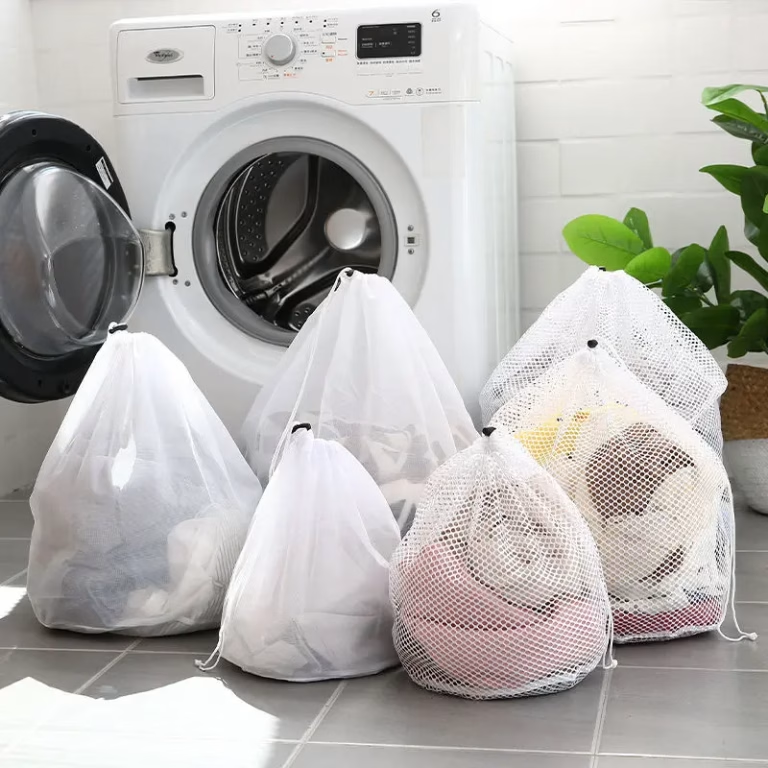
- Polyester mesh laundry bags: fine mesh, coarse mesh, honeycomb, sandwich/3D mesh, thickened.
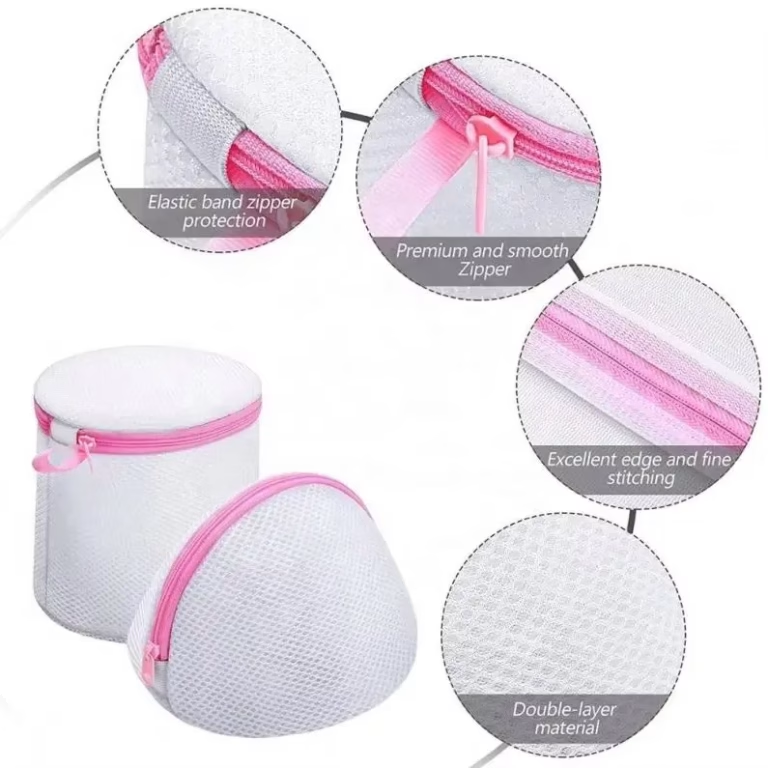
- Bra and lingerie wash bags, shoe and sneaker wash bags.
- Drawstring mesh bags, laundry bag sets (3/5/7 pieces).
- Bags with embroidered or custom logo.
- Disposable PE drawstring laundry bags for hotels and dry cleaners.
- Wheeled and folding laundry baskets, drying nets, bathroom hanging bags and storage bags.
Your inspection checklist must cover construction points for each type: seam strength, mesh hole size and consistency, zipper function, drawcord and cord lock, logo placement, packaging, and carton markings. If you are unsure about which material fits your market, see our Laundry Sack Bag Guide: Mesh vs Nylon vs Canvas Sacks. For evaluating a manufacturer before you even get to inspection, read Bra Laundry Bag Supplier Guide: How to Evaluate a Manufacturer.
On-Site Sampling Rules: Carton Selection, Piece Counting, and Defect Classification
The inspector must select cartons randomly, not just from the top or front of the pallet. A practical rule is to select approximately the square root of the number of master cartons, and take samples from different positions: top, center, bottom, front, back. For example, if there are 100 cartons, the inspector would pull samples from about 10 cartons. This is not a fixed mathematical formula for AQL, but it improves randomness.
The lot size must be the actual quantity to ship. If your PO is 4,000 pieces but the supplier packed 4,050 because of overproduction, the lot for AQL should be 4,050, not 4,000. Otherwise the sample and accept/reject numbers are based on the wrong lot size.
When counting defects, keep critical, major, and minor counts separate. If one unit has a major defect and a minor defect, that unit is recorded as one major only; the minor defect is not added to the minor total. If a unit has two major defects, it still counts as one major for that unit, but the inspector should document both defects for the report. The most severe defect rule prevents double-counting.
For multi-piece sets like a 3-piece laundry bag set, you can base the lot on pieces or sets. If you base it on pieces, a lot of 1,000 sets becomes 3,000 pieces and the sample size is larger, but each piece is checked individually. If you base it on sets, the inspector checks a set as one unit and any defect in the set counts against the set. With 10 or more pieces per set, counting per piece may lose meaning because a single set could dominate the defect count. Discuss with your supplier and inspection company before the inspection.
For continuous-flow production lines, continuous sampling plans—where you screen all units until stable, then sample, and return to screening on defect—can be a better fit than a one-time AQL sample. Discuss with your inspection provider if your order is produced in a continuous run rather than batch.
What to Expect in an AQL Inspection Report and What Happens on Failure
After the inspection, you receive a report with the lot information, sample size, defect counts by class, accept/reject decision, and photos of each defect. Good reports also include root-cause notes—for example, a seam failure traced to a specific machine or operator. Third-party inspectors are more likely to report true batch quality than factory self-inspections because they have no incentive to pass the shipment.
If the batch fails, the inspector documents the defects with photos and root-cause notes, and a corrective action report is provided. The supplier fixes the issues, and a re-inspection can confirm corrections. You usually pay for the re-inspection, so plan your timeline accordingly.
Common Mistakes Importers Make When Setting AQL (and How to Avoid Them)
- Using a percentage of lot size instead of the tables. The tables are non-linear; code letter drives sample size.
- Combining major and minor counts. Keep them separate; a lot can fail on major defects while still passing minor.
- Setting critical AQL above 0. This is almost never appropriate for consumer products.
- Not defining the defect list before inspection. If you do not tell the inspector what constitutes a major vs minor, you get inconsistent results.
- Ignoring multi-piece set issues. Decide pieces vs sets before the inspection; do not let the inspector decide for you.
- Forgetting to state the inspection level. If you do not specify, most companies default to General Level II, but it is better to write it in the booking form.
Before you book an inspection, make sure your supplier has a clear packing list and carton count. If you need help with bulk ordering or custom laundry bags, contact us through the Contact Us page or browse the Catalog to see the full range.
FAQ
What happens if the batch fails the AQL inspection?
The inspector issues a fail report with defect photos and root-cause notes. The supplier is expected to sort, repair, or reproduce the goods, and a re-inspection is booked to confirm the corrective actions. You should negotiate who pays for re-inspection before the first inspection.
How quickly can an AQL inspection be run?
Most third-party inspection companies can schedule an inspection within a few working days of your booking, once the goods are packed and ready. On-site inspection time depends on lot size and product complexity; a typical laundry bag order might take half a day to a full day. Always confirm the timeline with the inspection company before committing to a ship date.
Is AQL sampling the same as 100% inspection?
No. AQL sampling checks a random portion of the lot and accepts or rejects based on statistical limits. 100% inspection checks every piece, which is expensive and still not error-free. AQL is usually the right balance for consumer products like laundry bags, unless the order is very small or the defect risk is extremely high.
What is the difference between Special Inspection Levels S-1 to S-4 and General Inspection Levels I, II, III?
General levels (I, II, III) are used for non-destructive checks on normal products. Special levels (S-1 to S-4) give much smaller sample sizes and are usually reserved for expensive, labor-intensive, or destructive tests, such as fiber content or color fastness on a few pieces. For routine visual and functional checks on laundry bags, General Level II is the standard.
Does a major defect also count towards the minor defect count?
No. Critical, major, and minor defect counts are kept separate. If a unit has both a major and a minor defect, that unit is counted only as one major; the minor defect is not added to the minor total. This rule prevents double-counting and keeps the three classes independent.