
A rigid laundry basket is mostly air. You pay to ship that air, store it, and give it shelf space. For many buyers, that hidden cost is larger than the unit price suggests.
A fold up laundry basket fixes the problem at the source. It ships flat, stores flat, and opens in seconds when the end user needs it. But not every folding design holds up after a few months of real use. Frames bend, seams split, and handles tear.
Below, you’ll find the main types, the materials behind them, and the sizes that sell. You’ll also get seven checks to run before you order, plus notes on compliance and custom options. We’ve made laundry products since 2014, so the advice comes from the factory floor.
Quick answer: A fold up laundry basket is a laundry basket with a flexible frame or folding panels. It collapses flat for shipping and storage, then opens to full size for daily use. Most models use polyester mesh or fabric over a steel wire frame.
What Is a Fold Up Laundry Basket?
A fold up laundry basket is a hamper built to collapse. A rigid plastic or wicker laundry basket keeps one shape. A folding one changes shape on demand.
Most designs fold in one of three ways:
- Twist and fold. A spring steel wire frame twists into a flat disc.
- Fold flat. Side panels or support rods fold down, much like a tent.
- Compress. Flexible side walls push down into the base.
People use many names for the same product. You’ll see collapsible hamper, foldable laundry basket, and pop-up laundry hamper. Some shoppers even type “basket laundry basket” into a search bar. So your listings and packaging should cover several terms, not only one.
Who buys them? Mostly people with limited space. Think of students, renters, travelers, and families in small apartments. Hotels, campsites, and laundromats also use them, because they store flat between uses.
Key facts at a glance:
- Folded form: a flat disc or panel, usually a few centimeters thick
- Common materials: polyester mesh, polyester fabric, steel wire
- Typical uses: home laundry, dorms, travel, toy and linen storage
- Common add-ons: handles, lids, wheels, carry pouch
How does a pop-up basket fold?
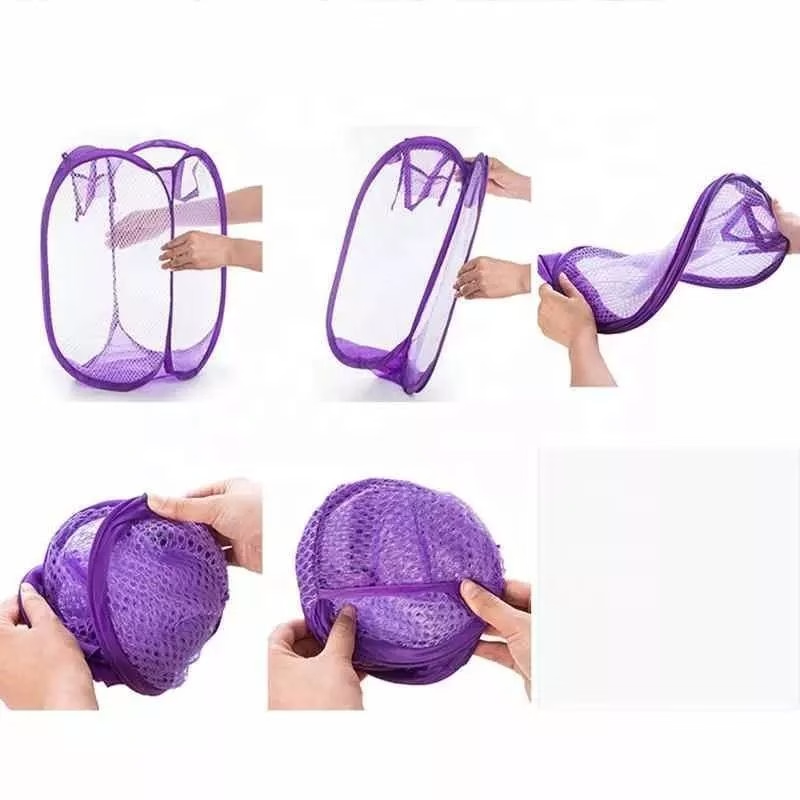
The twist fold confuses many first-time users. So clear steps on the insert card will cut returns. Here is the usual method:
- Empty the basket and stand it upright.
- Press the top ring down onto the base ring.
- Hold the flat circle at opposite sides.
- Twist your hands in opposite directions, so the ring forms a figure eight.
- Fold the loops over each other into one small disc.
- Secure the disc with the strap or slide it into its pouch.
Why Buyers Add a Fold Up Laundry Basket to Their Range
The case starts with freight. A rigid basket fills cartons with empty space, even when nested. A folding basket packs flat, so far more units fit in each carton and container. Because of that, the landed cost per unit often drops, even when the factory price is similar.
Storage works the same way. Flat-packed stock takes less warehouse space and less shelf space. For online sellers, a smaller parcel can also mean a lower shipping fee.
Then there is the end user. A folding basket is light, easy to carry, and easy to hide. For shoppers in small homes, that is often the whole reason to buy.
Here is how the two formats compare from a buyer’s seat:
| Factor | Fold up basket | Rigid basket |
|---|---|---|
| Units per carton | Many, packed flat | Few, nested or loose |
| Warehouse space | Low | High |
| Parcel size for online orders | Small and light | Bulky |
| Shelf display | Hangs on hooks or stands in a tray | Needs floor or deep shelf space |
| Load strength | Good for clothes; depends on frame and seams | Strong; holds heavy wet loads |
| Custom branding | Fabric print, labels, packaging | Mold changes cost more |
| Typical end user | Students, renters, travelers, small homes | Larger homes with laundry rooms |
A fair note: rigid baskets still win for heavy wet loads. So many retailers stock both. A folding line simply fills a gap that rigid stock can’t.
There is one more commercial point. Folding baskets pair well with wash bags. Many of our customers bundle them with laundry mesh bags for delicates to build a full laundry set. A bundle raises the order value. It also gives shoppers a clear reason to choose your set over a single item.
Four Main Types: Pop-Up Mesh Basket, Laundry Basket on Wheels, and More
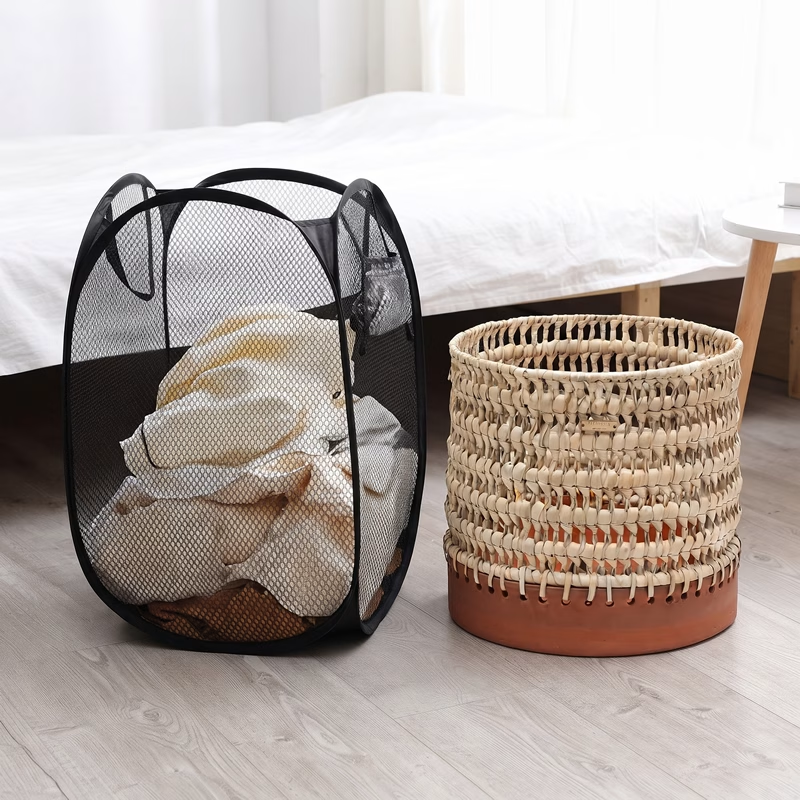
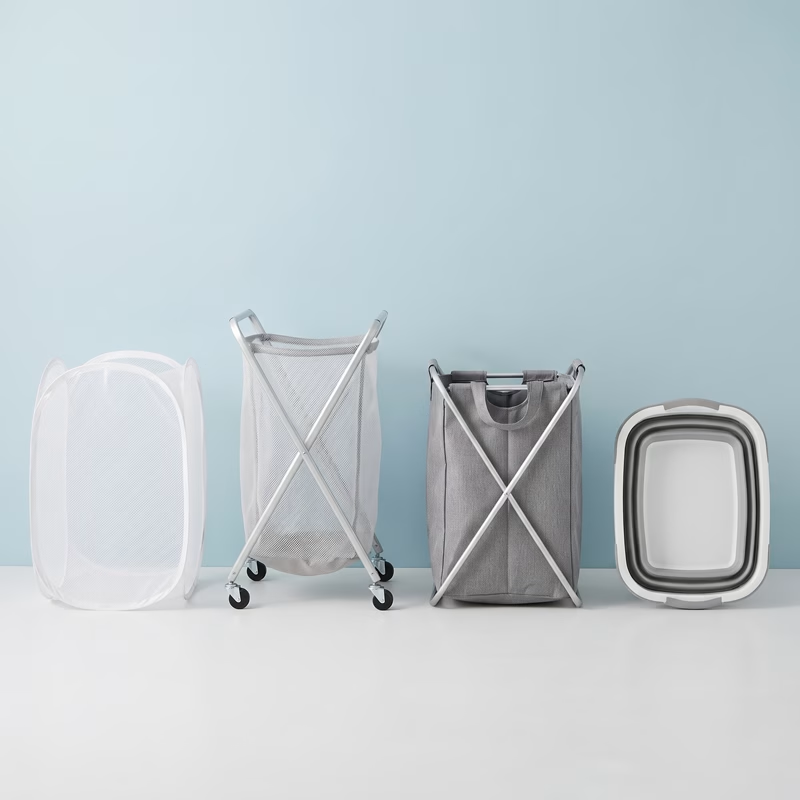
Folding baskets fall into four main groups. Each one suits a different customer and price point.
1. Pop-up mesh basket
This is the lightest and most common type. A spring steel wire frame is sewn into polyester mesh. Twist it, and it folds into a flat disc. Release it, and it springs open.
Mesh lets air pass through, so damp clothes can air out between washes. This type suits dorms, travel, and entry price points. Our breathable mesh laundry basket follows this approach, with a polyester body.
2. Rolling basket on wheels
Here, a frame with wheels carries a fabric or mesh bag. The user rolls it from room to room instead of lifting it. That helps older users and anyone moving large loads.
Our laundry basket with 4 wheels is one example. It uses polyester and measures 38 × 68 cm.
3. Fabric hamper with support rods
Polyester or Oxford fabric walls stay upright with slim rods or a wire rim. Remove the rods, and the hamper folds flat. This type looks more like furniture, so it suits bedrooms and gift sets. It also offers the largest print area for logos and patterns.
4. Folding plastic or silicone basket
This type has a hard rim and base with a flexible middle. It compresses like an accordion. It handles wet loads well, but it needs injection molds. So tooling costs are higher, and design changes take longer. Textile factories like ours don’t produce this type.
| Type | Frame | Folds into | Suits | Watch for |
|---|---|---|---|---|
| Pop-up mesh | Spring steel wire | Flat disc | Dorms, travel, promotions | Wire strength, seam binding |
| Rolling basket | Tube frame with wheels | Flat frame and bag | Families, older users | Wheel fit, frame joints |
| Fabric hamper with rods | Rods or wire rim | Flat panel | Bedrooms, gift sets | Rod pockets, base board |
| Plastic or silicone | Molded rims | Short stack | Wet loads, utility rooms | Tooling cost, hinge wear |
A related item: the folding drying net
Many buyers order a drying net along with their baskets. It hangs up and lets knitwear and delicates dry flat. Our three-layer folding drying net uses polyester and comes in transparent or custom colors. A closet or cabinet shelf is enough to store it after use.
Materials and Build: What Makes a Laundry Basket Last
Two baskets can look the same in photos. But they can perform very differently after six months. The reasons sit in four places.
Mesh and fabric. Polyester is the standard, because it dries fast and resists wear. Ask about mesh weight and hole size. Fine mesh protects delicate items from snags. Coarse mesh moves more air and costs less.
Frame wire. In pop-up designs, the wire does all the work. Thin or soft wire loses its shape after repeated folding. So ask what wire diameter the factory uses. Also ask whether the wire is coated against rust, since damp laundry sits against it daily.
Seams and binding. The wire runs inside a sewn channel. If that channel is weak, the wire end pokes through. Look for wide binding tape and dense, even stitching.
Handles. Handles carry the full load. They should be sewn into the binding with reinforcing stitches, not only tacked onto mesh.
Use this table when you compare quotations:
| Component | Common options | Question to ask your supplier |
|---|---|---|
| Mesh | Fine polyester mesh, coarse mesh, sandwich mesh | What is the fabric weight in gsm? |
| Frame | Spring steel wire, fiberglass rods, metal tube | What is the wire diameter? Is it coated? |
| Binding | Polyester tape, woven webbing | How wide is the tape? How are wire ends capped? |
| Handles | Webbing, self-fabric, padded grip | How is the handle fixed? What load was tested? |
| Closure | Open top, drawstring, zipper lid | Is the zipper rust-proof? |
| Wheels | Plastic casters | Do the wheels swivel? Do they lock? |
One note on eco claims. Buyers now ask more often about recycled polyester and safer dyes. Our raw materials are environment friendly, and we share material details with each quote. Still, always ask any supplier for documents instead of relying on a label claim.
What care advice should the packaging give?
Good care notes protect your reviews. Most folding baskets need only simple care, so keep the wording short:
- Wipe with a damp cloth, or hand wash in cool water.
- Air dry fully before folding, so the frame stays rust-free.
- Don’t overload the basket or drag it by one handle.
- Keep the folded basket strapped, because spring frames open fast.
Sizes and Capacity: Matching the Basket to the End User
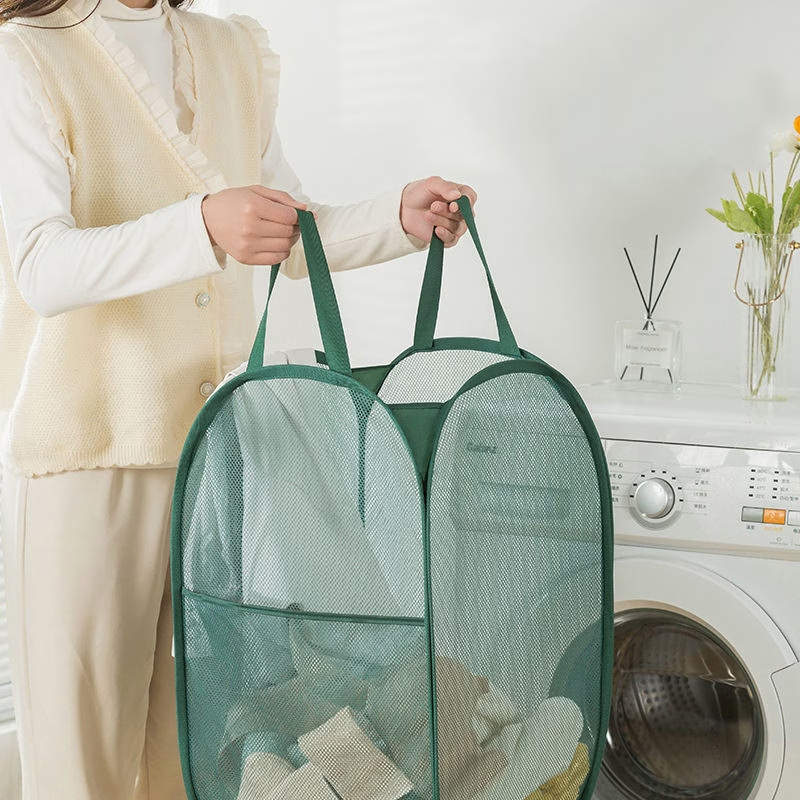
Size drives both price and customer reviews. A basket that’s too small overflows. One that’s too large won’t fit a closet.
These size bands cover most retail demand. Treat them as a guide, because habits differ by market.
| Band | Approx. capacity | Typical end user | Notes |
|---|---|---|---|
| Compact | 30–45 L | Travel, dorm rooms, baby clothes | Often sold with a carry pouch |
| Standard | 50–70 L | One or two people | The volume seller in most ranges |
| Family | 75–100 L | Families, shared homes | Needs a stronger frame and handles |
| Sorter set | 2–3 units | Homes that sort by color | Sold as a multi-pack |
Sorter sets deserve a closer look. Laundry guidance often tells people to sort clothes before washing. For example, Mississippi State University Extension’s laundry sorting advice recommends grouping clothes by fabric, with delicates handled apart. Two or three folding baskets make that habit easy. So a multi-pack in different colors can sell well.
A few practical points on size:
- Confirm two sizes in writing. You need the open size and the folded size, because both shape your carton plan.
- Agree on a tolerance. Hand measurement leaves small variances on any sewn product.
- Check the folded diameter. It must fit your shelf hooks, trays, or mailer boxes.
- Test a full load. Capacity in liters means little if the handles fail at half that weight.
Also think about height. A tall, narrow basket fits tight corners, but it tips more easily. A wide, low basket is stable, but it needs more floor space. Your sales data on room sizes and customer type should guide the choice.
7 Checks Before You Order a Fold Up Laundry Basket
Samples tell you more than any spec sheet. So run these seven checks on every sample before you approve it.
- Frame recovery. Fold and open the basket at least 50 times. It should spring back to full shape each time.
- Seam strength. Pull firmly along the binding. No stitches should pop, and no wire end should show.
- Handle load. Fill the basket with damp towels and lift it by the handles. Carry it for a minute, then inspect the stitching.
- Mesh surface. Rub a knit garment against the mesh. It should not snag or pill.
- Folded size. Measure the folded unit, then confirm the units per carton with your supplier.
- Chemical compliance. Ask for test reports that match your market. For Europe, that usually means REACH.
- Labels and packaging. Check that folding steps appear on the insert. A short safety note about the spring frame also helps.
Check six needs more detail. For Europe, chemical rules for products sit under REACH, short for registration, evaluation, authorisation, and restriction of chemicals. Lawmakers wrote it so that chemicals in everyday goods harm neither people nor the environment. Buyers should look first at Annex XVII, where restricted substances appear. For sewn laundry products, the focus is usually on dyes, coatings, and metal parts. You can read more in ECHA’s overview of the REACH regulation.
Our products can pass REACH and related tests. Still, ask every supplier for a recent report from an accredited lab. The report should name the actual product or material, not a similar one. Also check the report date and the list of substances tested.
Buyers in North America, Korea, and Japan often work with their own lists. So share your market’s rules early. Then testing can be planned once, before bulk production starts.
OEM and Custom Options for Your Basket Line
Custom work is where a folding basket becomes your own product. Because the body is sewn, changes cost far less than a new plastic mold.
Common options include:
- Size and shape: round, square, or rectangular; single or multi-compartment
- Color: mesh, binding, and handle colors matched to your brand
- Branding: printed logo, woven label, rubber patch, or hangtag
- Features: lid, drawstring top, side pocket, wheels, or carry pouch
- Packaging: polybag with insert card, belly band, color box, or multi-pack
What should a quote request include?
A clear brief speeds up quoting and cuts sample rounds. Therefore, include these seven points:
- Target size, both open and folded
- Material and color references
- Logo files and print position
- Packaging type and barcode needs
- Order quantity per size and color
- Target market and required tests
- Delivery date and shipping terms
How does a custom order usually run?
Most custom orders follow the same path:
- Brief and quotation. You share the specification, and the factory prices it.
- Sampling. The factory makes a sample to your size, color, and logo.
- Approval. You test the sample with the seven checks above and confirm changes.
- Bulk production. Cutting, sewing, and packing start after you sign off.
- Inspection and shipment. Goods are checked against the approved sample, then shipped.
One tip from experience: keep a signed sample on both sides. Then, if a question comes up later, everyone compares against the same reference.
Work Directly With the Factory Behind the Product
Every point above gets easier when you talk to the people who cut, sew, and pack the product. A trading company passes your questions along. A factory answers them.
We’ve manufactured laundry mesh bags, bra laundry bags, shoe washing bags, storage bags, laundry baskets, and drawstring mesh since 2014. Our customers are in Europe, North America, South America, Korea, and Japan. OEM orders are welcome, and custom designs are available.
So if a folding basket line is on your list, send us your brief. Tell us the size, the material, the quantity, and your market. We’ll reply with a quotation, material details, and sample options. You deal with the original manufacturer from the first message to the final shipment, with direct access to the source.
Frequently Asked Questions
1. What is the minimum order quantity for folding baskets?
It depends on the size, material, and print. Stock designs usually need lower quantities than fully custom ones. Send us your specification, and we’ll confirm the exact figure with your quote.
2. Can you customize size, color, and logo printing?
Yes. OEM orders are welcome, and custom designs are available. You can set the size, mesh color, binding, logo, and packaging. Reach out for detailed specifications and print options.
3. Do your laundry baskets pass REACH testing?
Yes, our products can pass REACH and related tests. Our raw materials are also environment friendly. Tell us your market, and we’ll plan the right testing for your order.
4. How long does production take for custom orders?
Lead time depends on quantity, materials, and the season. Sampling comes first, and bulk production follows your approval. Share your delivery date, and we’ll confirm a schedule in the quotation.
5. Can I request samples before placing a bulk order?
Yes. We recommend testing a sample before any bulk order. Contact us to request samples in your preferred size and color.