
A sweater drying rack needs to fit both the garment and the place where it will be used. A compact frame is little help if the sleeves hang over its edges. A generous mesh surface is equally inconvenient if its feet cannot sit securely on the available countertop.
For importers, distributors and private-label buyers, selection starts with four connected questions: what garments need support, how much usable mesh is available, what holds the net in place, and where it will be stored. These questions also provide a practical structure for product specifications and retail instructions.
Flat Mesh Support and Airflow for Sweater Drying
When a sweater’s care label specifies flat drying, the aim is to support the garment without suspending its wet weight from the shoulders or leaving sections hanging over an edge. Mesh provides an open supporting surface, while clearance beneath it gives air a path around the underside.
Look at the complete assembly rather than the mesh alone. A loosely supported panel can sag into a bowl; a frame or attachment arrangement must hold the surface appropriately under the intended load. Mesh openings also need consideration alongside the garment: an open structure should still provide suitable support for the knit.
During sample evaluation, lay out representative sweaters with their bodies and sleeves supported. Check whether the fabric collects in the centre, whether seams or frame edges create concentrated contact, and whether the garment touches the surface below. A product photograph with an empty net cannot answer these questions.
Flat support addresses how the garment rests during drying. It does not establish that a particular product prevents stretching, shrinkage or creasing. Keep garment-care instructions central to the product’s intended use.
Choosing Between Freestanding, Hanging and Rack-Mounted Nets
The main formats solve different placement problems. Choose the format before comparing accessories or packaging.
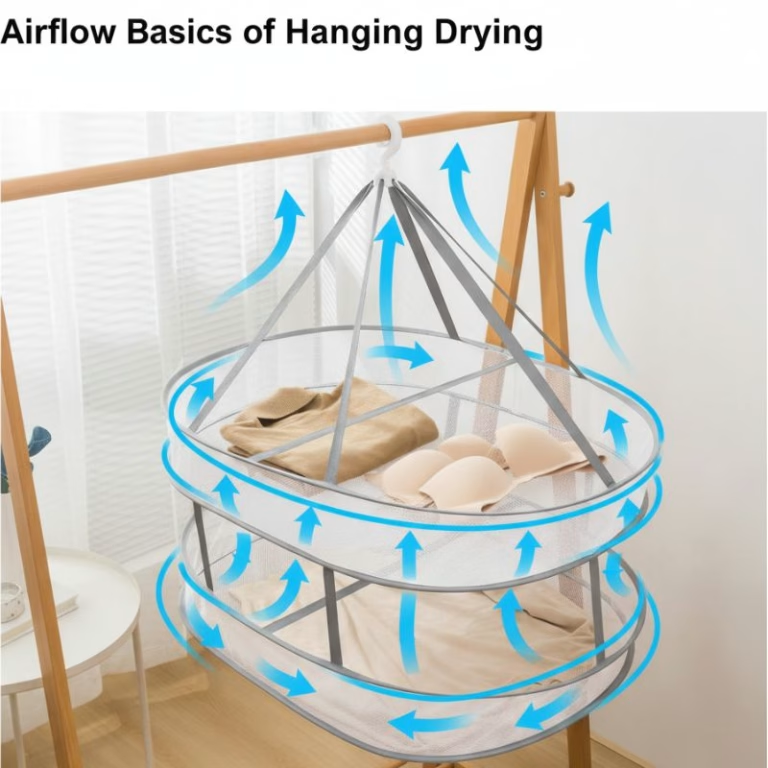
- Freestanding nets: A raised mesh platform sits on its own feet. Evaluate the support footprint, stability, clearance beneath the mesh and access for laying out sleeves.
- Hanging nets: Mesh platforms hang from a hook or suspension assembly. Check the hanging point, overall drop, balance and room needed to load each level.
- Rack-mounted nets: A mesh accessory fits onto an existing clothes rack. Compatibility depends on rack dimensions, attachment positions and the tension needed to support the garment.
A freestanding net provides its own support, while a rack-mounted accessory relies on a separate clothes rack. These examples highlight an important purchasing distinction: some products supply the complete support structure, while others depend on equipment the customer already owns.
For an accessory, define the intended rack fit and list every supplied attachment. Avoid packaging that shows clips or supporting equipment without making clear what the customer receives. For a complete platform, show how its legs or suspension parts are deployed.
Hanging nets, hanging nets with guards and freestanding models offer different support arrangements. Treat these as useful format examples when planning an assortment, rather than assuming that every customer in a region wants the same design.
Comparing Drying-Surface Dimensions and Placement Footprints
Ask for separate measurements for the usable drying surface, the open assembly, the supporting footprint and the folded product. Each answers a different buying question.
- Usable drying surface: How much space is available inside borders, guards and frame members?
- Open dimensions: How much room does the whole product occupy during use?
- Supporting footprint: Where must the feet, clips or other contact points rest?
- Folded dimensions: What space is needed in a cupboard, retail pack or storage bag?
When a freestanding dryer’s legs sit inward from the corners, its drying surface extends beyond its supporting footprint. This illustrates why overall width alone cannot establish countertop fit. Check the positions of the feet as well as the space around the overhanging frame.
A selection guide may suggest a mesh size for a particular sweater size. That is a guide-specific recommendation, not a universal garment-size standard. Sweater body width, sleeve length and cut need to be considered together.
For sourcing, send the supplier the laid-flat dimensions of representative garments and the intended sleeve arrangement. For a circular net, check the actual garment outline against the available circle: its widest measurement does not describe the space available near every edge. Retail photographs should show the intended layout clearly.
Matching the Net to a Countertop, Existing Rack or Bathroom
Countertops and laundry appliances
Start with the dimensions of the supporting surface and the locations of all feet. Check that the loaded platform remains stable and leaves enough clearance around nearby walls, taps and doors. If appliance-top placement is intended, follow the appliance manufacturer’s instructions and assess the proposed use accordingly.
Consider moisture as well as fit. Follow the garment’s care instructions for removing excess water before laying it out, and choose a location where remaining drips will not damage the surface below.
Existing clothes racks
For a rack-mounted net, obtain a drawing showing attachment positions and the intended mounting span. Evaluate the sample on the rack configurations relevant to the target assortment. Check that clips or straps remain seated and that the loaded mesh does not rest against bars in an unintended way.
A compatibility description is more useful than a broad claim that an accessory fits every rack. Installation instructions should show attachment order and the finished position of the mesh.
Bathrooms and bathtub placement
For a drying net intended for bathtub use, check the specified mesh material and included fittings against the proposed installation. This is a placement-specific example; its material and fittings should not be assumed to apply to other drying nets.
For bathroom products, specify the intended support points and available clearance. Check access to the bath or shower while the product is installed, along with a suitable place to put it after use. A bathroom location still needs appropriate ventilation.
For broader room layout and spacing advice, see Hanging Clothes Drying: Faster Indoor Results.
Comparing Layers, Hooks, Guards and Folded Storage
Extra layers should be assessed with garments in place. Check the clearance between levels, the ease of reaching the lower surface and whether loading one side tilts the assembly. Count usable drying positions rather than judging capacity from an empty product image.
If a hanging net has a locking feature, its presence alone does not establish resistance to detachment in wind. For procurement, distinguish a feature description from a demonstrated performance limit. Inspect how the lock closes, how it fits the intended hanging point and how the user can confirm engagement.
For a circular hanging net, assess the usable diameter, hook design and folding arrangement. Diameter, suspension security and storage are separate specification items; none replaces an assessment of the loaded assembly.
For guarded designs, check the height and construction of the edge, how easily garments can be placed inside, and whether the guard interferes with sleeves. For folding products, ask for both packed and folded dimensions, then assess how clearly the folding sequence can be explained on the packaging.
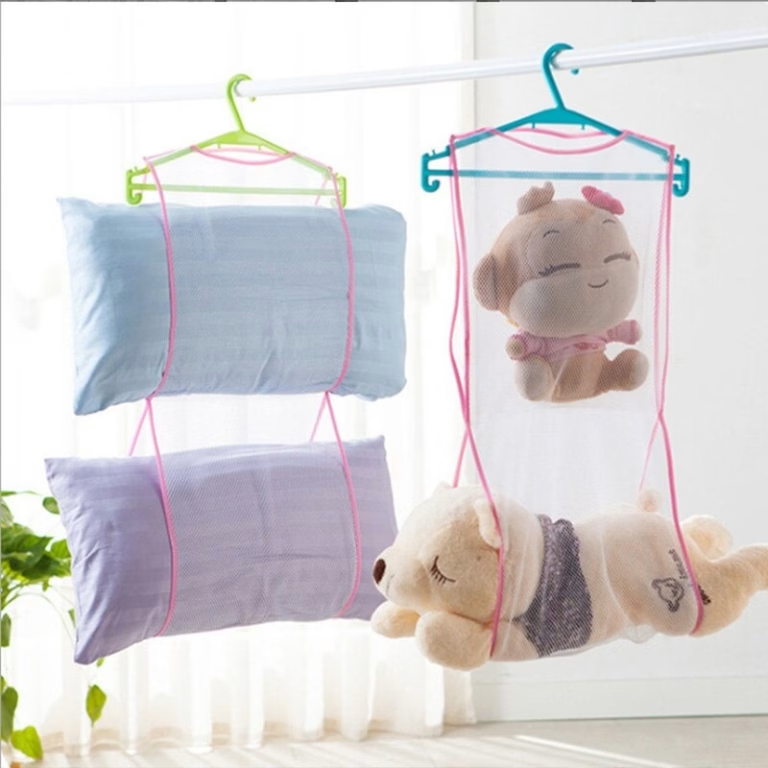
A net’s suitability for sweaters does not establish its suitability for pillows, cushions or stuffed toys. Those uses require their own assessment of dimensions, loading and care instructions. The related guide, Drying Net vs Drying Rack for Pillows, Cushions and Plush Toys, discusses that selection separately.
Drying Nets in a Laundry-Accessories Assortment: OEM and Custom Designs
Yiwu Yihang Daily-Use Commodity Co., Ltd., based in Yiwu, Zhejiang, China, has manufactured laundry and storage products since 2014. Drying nets are part of its listed product range, and Europe and Japan are among its main markets. OEM orders and custom designs are welcome.
For a sweater-drying project, prepare a brief around the intended use rather than starting with a photograph alone. Include:
- Representative garment dimensions and the intended drying position.
- Preferred format and intended indoor or outdoor placement.
- Required usable surface, supporting footprint and storage envelope.
- The proposed mounting arrangement and parts to be included.
- Packaging language, installation illustrations and garment-care guidance.
- The sample checks and evidence needed to support proposed product claims.
Agree on the proposed construction and sample specification before finalising retail copy. Keep product dimensions, materials and mechanisms tied to that specification; examples from other listings are useful discussion references but do not define the company’s offering.
Review the product catalog for the broader laundry-accessories range, or contact the company with your drying-net brief to discuss an OEM or custom-design enquiry.
FAQ
How should clothes be arranged on a drying rack?
Follow each garment’s care label and leave space between items. For sweaters requiring flat drying, support the body and sleeves on a suitable horizontal surface. Gently arrange the garment into shape without pulling it taut, and avoid leaving sections hanging over an edge.
Which type of drying rack is most suitable for sweaters?
For sweaters labelled for flat drying, look for a stable horizontal surface large enough to support the garment. Freestanding, hanging and rack-mounted nets can be considered according to the available space, mounting arrangement and garment dimensions.
What drying method works best for sweaters?
The care label determines the appropriate method. When it calls for flat drying, remove excess water as instructed, arrange the sweater on a suitable supporting surface and allow it to dry with ventilation. Do not assume that the same drying method suits every fibre or knit construction.
What options are available for drying a sweater without a dedicated rack?
If the care label permits flat drying, use a clean, dry towel on a flat surface that tolerates moisture. Support the whole garment and replace the towel when it becomes damp. Keep the drying area ventilated and follow any care-label restrictions on heat or sunlight.