
Introduction to Wholesale Mesh Laundry Bags for Importers
When you source mesh laundry bags in bulk, a product page with a few photos and prices is not enough to make a confident decision. Importers, distributors, and commercial facility managers need to compare material specifications, closure types, sizing standards, and factory capabilities before committing to a purchase. This guide cuts through the listing-style noise and gives you the practical points that matter on the sourcing side.
We are Yiwu Yihang Daily-Use Commodity Co., Ltd., a manufacturer in Yiwu City, Zhejiang, China. We have produced laundry mesh bags, washing bags, laundry baskets, storage boxes, and dirty clothes baskets since 2014. Our main markets include Europe, North America, South America, Korea, and Japan, and we welcome OEM orders and custom designs. Our product range covers polyester mesh in fine, coarse, honeycomb, sandwich/3D, and thickened varieties, as well as disposable PE drawstring bags for hotels and custom embroidered logo bags.
For a broader overview of wholesale options, see our bulk mesh bag manufacturer page.
Material and Density: Choosing the Right Mesh (Denier, Honeycomb vs. Fine)
The first technical decision is fabric weight and weave. Commercial laundry bags are often constructed from 420 Denier fabric for heavy-duty applications, such as dragging across concrete floors, while 210 Denier is typically used for standard commercial settings. Denier measures fiber thickness; higher denier means heavier, more abrasion-resistant yarns. For laundromats, hospitals, and gym facilities that process large loads, 420D is the safer baseline if bags will be moved on rough floors.
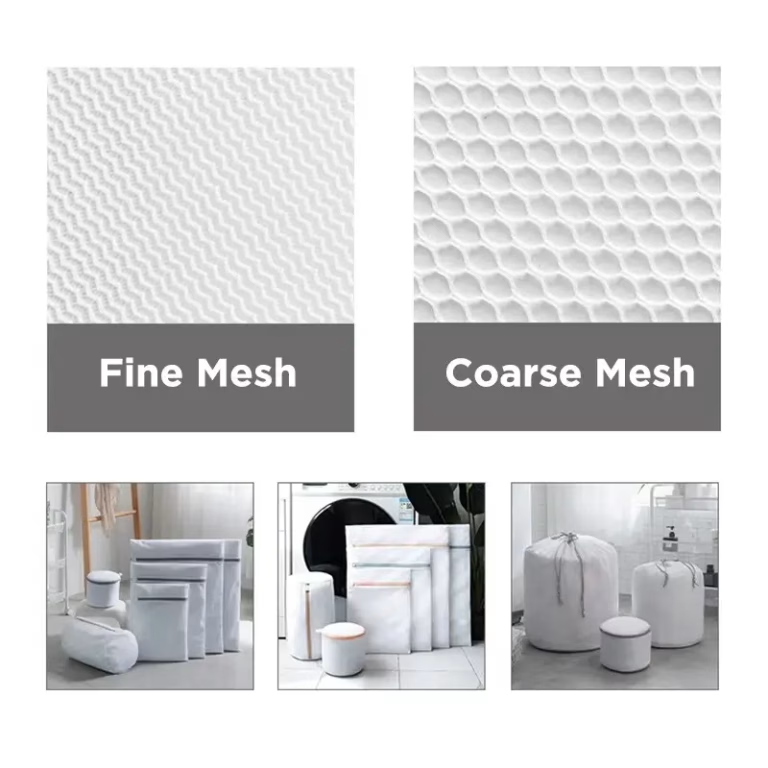
Mesh style affects both durability and water exchange. Fine mesh (often used for delicates) prevents snagging but drains more slowly. Coarse mesh allows faster water and detergent penetration, which suits towels and uniforms. Honeycomb mesh has a more open knit that provides extra strength during the wash cycle; it can be manufactured using a durable 125g material. This 125g weight is common in Spanish-speaking markets that ask for honeycomb by gram weight rather than denier.
Some importers in Japan specifically request double mesh (Wメッシュ) designs. Double mesh laundry bags feature a layered construction: a coarse outer mesh and a fine inner mesh. The outer layer takes abrasion, while the inner layer reduces friction on fabric, protecting garments better than a single layer can. For undergarment lines, specialized cylindrical bra washing nets are often designed around 16 cm diameter and incorporate a protective plastic ring to keep wire bras from losing their shape. If you sell into the Japanese market, these two features—double mesh and stiffened cylindrical bra nets—are worth adding to your product range.
Eco-friendly segments are also growing. Wholesale mesh bags made from organic cotton mesh fabric, paired with a cotton drawstring and plastic stopper, appeal to buyers who want plastic-free packaging and a natural fiber story. These are often smaller-volume and higher-price than polyester, but they can open doors to boutique retailers and green brands.
For a deeper comparison of mesh types and their uses, read our buying guide for laundry mesh bags.
Standard Sizes and Shapes for Commercial Use
Commercial buyers usually order a mix of sizes to cover different tasks. Standard dimensions range from smaller 12 x 12 inch bags for delicates, socks, and personal items, up to heavy-duty 30 x 40 inch counter bags used by commercial laundries and hospitality laundry rooms. Cylindrical laundry bags are popular in European and Asian markets; common diameters include 30 x 30 cm, 40 x 40 cm, and 50 x 50 cm. The smaller cylindrical sizes are often used specifically for washing socks and delicates, while larger ones handle towels or uniforms.
A useful feature for wash-and-fold services is a flat PVC bottom. Wash and fold businesses frequently use laundry bags designed with a flat PVC bottom because it allows them to neatly stack folded clothing for customers. A bag that can stand open on a shelf or cart speeds up folding and packing work. If your customers run commercial laundry operations, ask your manufacturer about adding a reinforced PVC or coated base instead of a simple sewn seam.
For institutional buyers looking at full product lines, check our commercial and institutional mesh laundry bags page.
Closure Options: Zippers, Drawstrings, and Clips
Wholesale mesh bags come with a variety of closure mechanisms, including self-locking zippers, drawcords with ID tags, rubber ties, and alligator clips. Each has trade-offs.
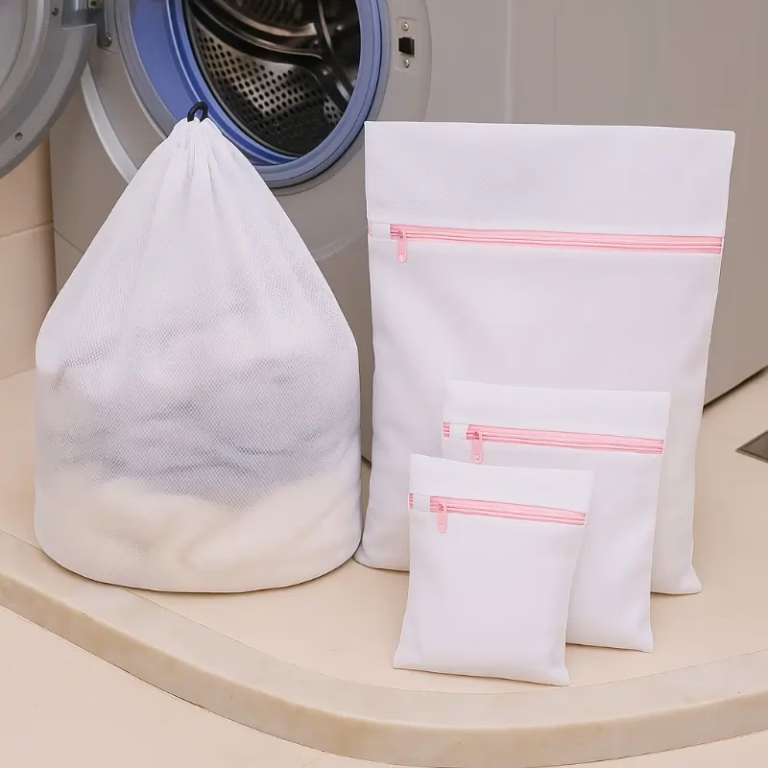
- Self-locking zippers: keep the bag closed even when tossed in a commercial washer. They also stop small items from escaping. Look for zipper heads that will not scratch washer drums; many factories offer covered or plastic zipper pulls.
- Drawcords with ID tags: allow easy opening and closing, and the ID tag can be printed with a room number or customer name. Useful for hotels, gyms, and student housing where bags are personalized.
- Rubber ties and alligator clips: low-cost, fast-closing options. They may not be as secure as zippers, but they are fine for lightweight loads and short cycles.
When you order OEM, these components can usually be color-matched or branded. For more on choosing the right closure for your application, see our buying guide. The same page also covers the trade-offs between zipper and drawstring style in different commercial environments.
Customization and OEM Options for Bulk Orders
As a factory based in Yiwu, we handle custom orders for importers in Europe, North and South America, Korea, and Japan. The product range includes polyester mesh bags in fine, coarse, honeycomb, sandwich/3D, and thickened constructions, plus disposable PE drawstring laundry bags for hotels and dry cleaners. Custom embroidered or printed logos are common for private-label brands and hospitality contracts.
When you request OEM or ODM work, you can specify bag size, mesh density, closure type, color, and packaging. Many buyers also ask for custom inserts, hang tags, or retail-ready packaging. Because every order is different, exact minimum order quantity, unit price, lead time, and production capacity depend on your specifications. Importers can request exact minimum order quantity, unit pricing, production lead time, and current production capacity data for their specific custom orders. It is best to send your target dimensions, material preference, closure, and packaging idea so the factory can quote accurately.
For a general overview of wholesale pricing and bulk ordering, visit our laundry bag wholesale bulk page.
Factory Insights: Lead Times, MOQ, and Cost Structure
Wholesale mesh laundry bag pricing is driven by five main factors: fabric weight and type (denier or grams per square meter), bag size, closure mechanism, printing or embroidery, and packaging. A 420D heavy-duty bag with a self-locking zipper and PVC bottom will cost more than a 210D drawstring bag of the same dimensions. Honeycomb and double mesh add process steps and fabric cost. Organic cotton mesh is the most expensive base material per unit because the fabric itself is pricier and production runs tend to be smaller.
Lead times in Yiwu mesh bag factories typically follow fabric availability, printing, and sewing capacity. Yiwu Yihang has produced laundry mesh bags, washing bags, laundry baskets, storage boxes, and dirty clothes baskets since 2014, and serves importers in Europe, North America, South America, Korea, and Japan. Seasonal demand patterns in these markets affect production scheduling. However, we do not publish blanket MOQ or lead time figures because each order differs. Minimum order quantity for plain polyester mesh bags depends on the design, materials, and closures; our team confirms the current minimum with your quote. Lead time for a typical container order after sample approval depends on the season and production schedule; our team confirms the current timeline with your quote. Unit price depends on the bag’s dimensions, fabric weight, closure type, and order quantity; our sales team provides a current quotation for your specification. These figures are only to give you a ballpark; request a formal quotation for your exact spec.
To extend the lifespan of commercial laundry bags, facility managers recommend washing the bags themselves in cold water and avoiding overstuffing, which stresses the seams. This maintenance point matters for your end-users and can reduce warranty issues. Share it with your customers.
For a structured look at evaluating bulk suppliers, see our bulk laundry bags buying guide.
FAQ
Can you put mesh laundry bags in the dryer?
Yes, most polyester mesh laundry bags can go in the dryer on low or medium heat. However, zippers and plastic components can become brittle over time, and high heat may shrink some drawcords. Air drying extends the bag’s life. For a detailed answer, see our dryer guide.
How do I wash shoes in a washing machine with a mesh bag?
Place one pair of shoes inside a medium or large coarse mesh bag, close the zipper or drawstring securely, and wash on a gentle cycle with cold water. The bag keeps shoes from banging the drum and reduces tangling of laces. Remove insoles and laces if possible. For full steps, search the blog archive for shoe washing guides.
What is the best material for commercial laundry bags?
For most commercial settings, 420 denier polyester is the best balance of abrasion resistance and cost. Use 210 denier for lighter institutional use where bags stay on carts and shelves. Honeycomb mesh with 125g weight adds strength for wash cycles, and double mesh provides extra fabric protection for Japanese market segments or premium lines.
How do I choose the right mesh density for my wholesale order?
Match mesh density to the items being washed and the wash environment. Fine mesh for delicates and bras, coarse mesh for towels and uniforms, honeycomb for heavy loads, and double mesh for garments that need friction protection. If you are unsure, order samples of two or three densities and run them through a commercial washer to test drainage, snag resistance, and durability.